
Barrelhouse Reviews: THALASSA by leena aboutaleb
Reviewed by Jess Yuan
Game Over Books / July 2026 / 90 pp
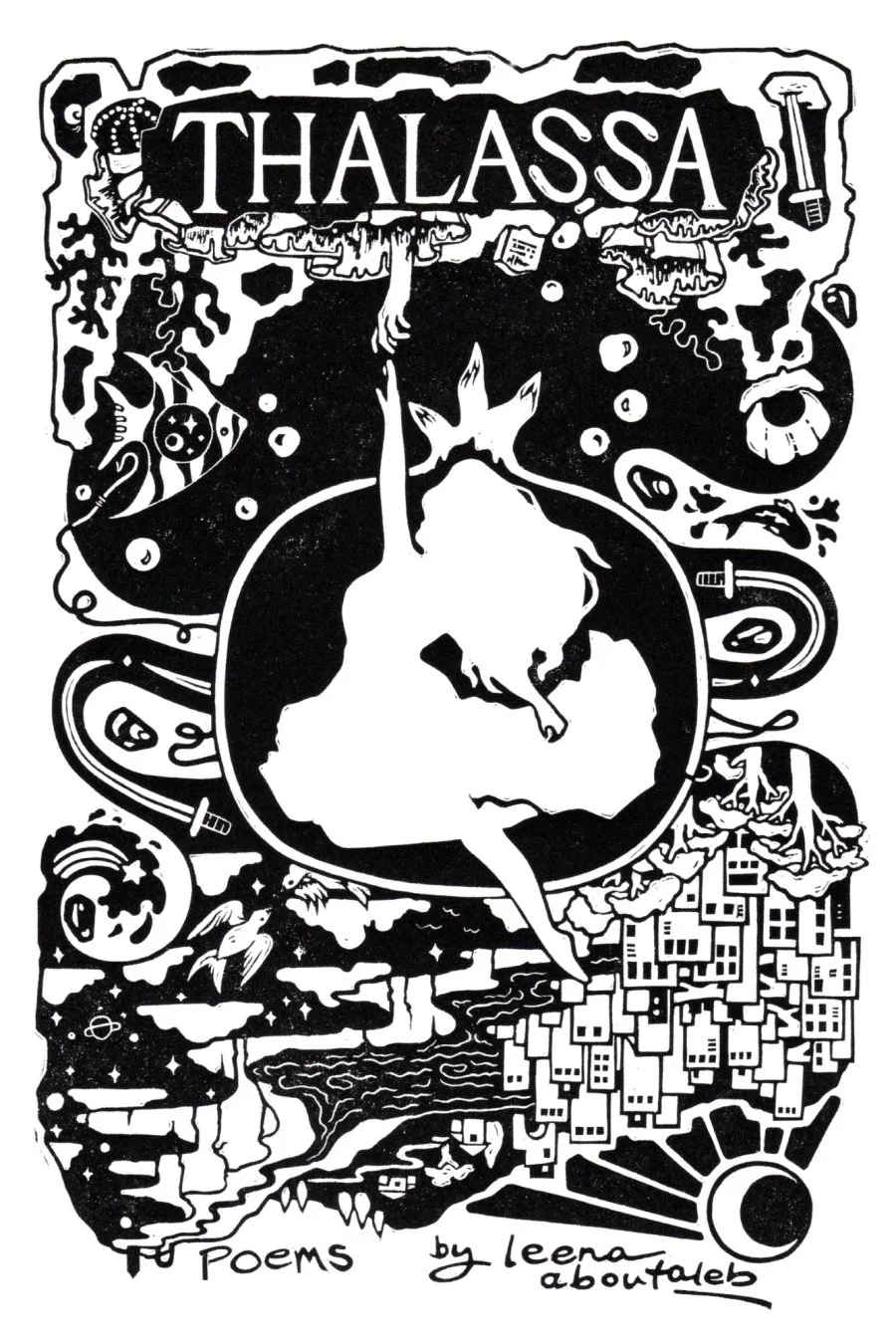
THALASSA submerges us in depths of grief as if in the depths of the ocean. The title brings to mind thalassophobia, the fear of deep bodies of water. These poems open an abyss: bottomless, unending, and unknowable. But THALASSA exceeds the realm of phobia, expanding to hold fascination, the horror of being irresistibly drawn to a terrible sublime—the essence of which aboutaleb imbues in each of her poems.
With “Emerald-Eyed [Sacrifice of Love],” THALASSA begins:
For you, I will burn the world down
until the end is silvered fragments,
rivering like a scorpion’s lungs.
Eternalised: the myth of a sister who lost brother.
Yousef, I will never remove the dagger.
It is for Yousef that the speaker writes and cannot stop writing, cannot “remove the dagger.” “Emerald-Eyed [Sacrifice of Love]” is thirteen lines, one short of a sonnet, and leaves an additional empty line above the last, where a traditional sonnet would volta into the last couplet. Yousef’s name is invoked after the pause of that empty space, an emptiness unresolved despite the speaker’s fearless declarations. In a bookend to the collection, the last poem is also a direct address in the words of a spoken obituary. From beginning to end, the poems insistently revolve around the loss of Yousef.
“I fall into the next world,” aboutaleb writes. “The children repeat the story: a sister dove headfirst into the underworld. I am in the depths, in search for a light that never falls.” THALASSA recounts again and again a story of sister and brother, a mythology of grief and of personal and political histories. “The children repeat the story” and the speaker “eternalise[s] the myth,” but the pain of that myth will never cease. It falls into a bottomless ocean. These lines take us from the depths of the sea to the darkness of the underworld, as if the ocean has no floor and seamlessly descends ever further into the land of the dead.
The landscape of grief takes us not only to the watery underworld, but also to strange and speculative spaces. A single poem, “ENTRY TO THE UNDERWORLD,” is followed by a sequence of prose poems spread throughout the book, each titled “ENTRYWAY TO CAPITAL.” In “ENTRYWAY TO CAPITAL VI [SPECTRAL LINES],” the speaker builds a world both familiar and unfamiliar: “The world is asleep. Fog thick. I want to describe for you the sky today. Hang gilders. Liberation. It will not last. But today it is so beautiful, and so today I remember you. 17 and a country stolen. Did you grieve?” These fragmented sentences offer glimpses into the world of the poem, a world the poet “wants to describe” but knows “will not last.”
The “CAPITAL” is a place of power and empire. Each of the “ENTRYWAY TO CAPITAL” poems is followed by a phrase in brackets, taking us through the capital by way of the [PRIESTESS], [MARTYRS], and [DUST], among others. Like the icons of a tarot deck, these poems offer a prophetic vision of a haunting world. Each poem is laid forth page by page like a tarot reader drawing cards. They feel like oracles, like archetypes.
Among the spaces of empire, however, are also spaces of tremendous nostalgia and hope. In another prose poem, “NEW WORLD ORDER AT THE CENTRE OF MY LOVE,” aboutaleb writes, “Once a year, I slice my palm open and refill the city; the lights go on and off for a moment then the electricity whizzes right back on. Look, here’s the cinema, the pottery classes, the writer’s guild, the film studio, the MEMORY MINISTRY—”
The “MEMORY MINISTRY” offers an evocative opening into the speaker’s past. aboutaleb journeys into memory, “Inside the bird cage is a text, inside the text is a tunnel, inside the tunnel traces in Dibben, in Dibben the tunnels are fenced inside wire, inside the wire is abandoned medical kits and old comics, the leaflets flying in whispers of old weapons. Past Dibben and honour fictional martyrs. Pass the seabed of our childhoods and honour the pearl-divers. The first week after I learned to fly, I forgot my name.” The procession of the journey moves with the rhythm of parallelism; the memories nest “inside” one another, then “past” one another into forgetting. The memory feels as if it’s fading even as it’s retold. It becomes dreamlike, detached from reality, drowning in intense longing.
Any review of THALASSA would be remiss to not highlight the series of poems written in solidarity with Gaza and Palestine. “The universe began on October 7,” aboutaleb writes, “I am in the middle of a haunting[.]” Grief for familial loss becomes grief for the dead of Gaza, as the speaker writes to her grandfather, “Jiddo, today I write to you on another death day. Today I mourn a giant of a man, Refaat Alareer and his loved ones.” The poet appears in the act of writing; she repeats that it is “today” that she writes and mourns. The immediacy of “today” grounds the urgency of the poem. And yet, the urgency of “another death day” becomes part of the rhythm of daily life, collective loss interwoven with the threads of family loss.
In excerpts from this poem, “What about witnessing do you want to remember?,” grief is not an end in itself; it calls us to action. The poem moves from the “I” of the speaker to the solidarity of the collective first person, “We are in this body, split across Asia. We count the solidarity stickers and rip the posters[.]”
When we have suffered the profound depths of personal grief, how can we bear to fully grieve the tragedy of each and every unjust death around us? THALASSA attempts to hold all this loss. In this collection, rage is inseparable from grief, and personal grief is impossible to untangle from political and historical rage. aboutaleb fearlessly asks, Is it possible for grief and rage to build towards justice? Can grief and rage unmake empires?
Jess Yuan (she/her) is a poet, educator, and architect. She is the author of Slow Render (2024), winner of the Airlie Prize, and Threshold Amnesia (2020), winner of the Yemassee Chapbook Contest. Jess is a Kundiman fellow and holds an MFA in Poetry from the Johns Hopkins Writing Seminars. Her poems appear in Best New Poets, Tupelo Quarterly Review, jubilat, Beloit Poetry Journal, and elsewhere. She is the Director of Intermediate Studios at Boston Architectural College.