
Barrelhouse Reviews: A Bad Deal in Mormon Land by T.I.M. Wirkus
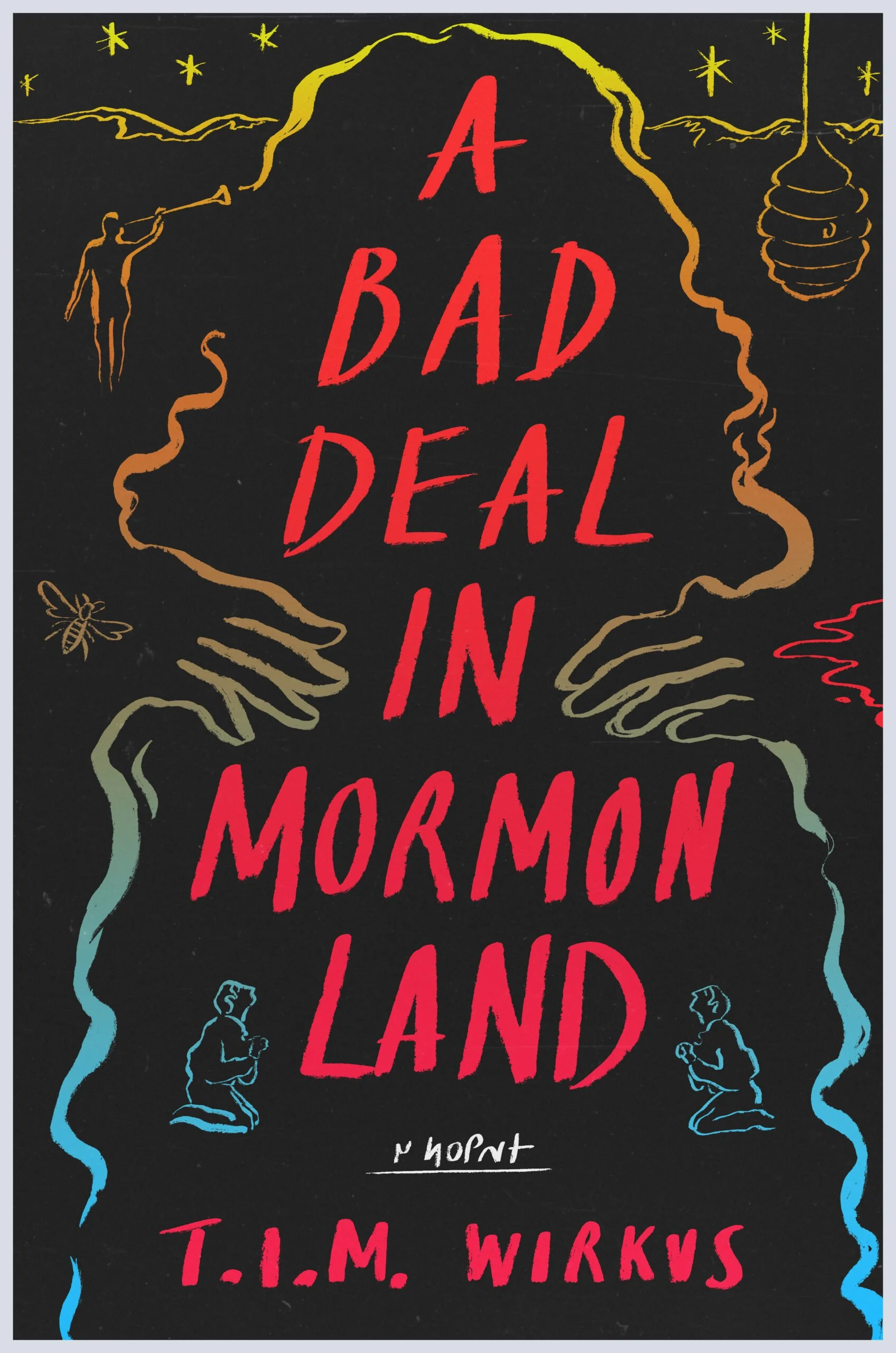
Reviewed by McKenzie Watson-Fore
Type Eighteen Books / October 2026 / 308 pp
T.I.M. Wirkus’s latest novel is energetic, suspenseful, and nearly florid. Its stylistic exuberances fit the trappings of Wirkus’s project: a tale of vaudeville and theatricality, authority and deception, crammed like a Victorian steamer trunk full of disguises, props, and pistols. A historical novel set in 1908, the book provides a highly textured glimpse into early-twentieth-century Salt Lake City and the workaday lives of performers passing through.
The plot centers on a seance conducted by self-styled spiritualist and grifter Madame Ilsa von Hoffman, hired by the recently excommunicated Mormon Elder Roger Marsh to conjure the ghost of Joseph Smith. Marsh has seen a vision in which Joseph Smith, summoned by the medium, will endorse Marsh’s version of the true Church, characterized by its ongoing practice of celestial marriage—polygamy—which has been renounced by the Quorum of the Twelve Apostles. Despite his excommunication, Marsh is unrelenting in his convictions about the inextricability of celestial marriage from the work of the Church.
“I have a sure knowledge,” Marsh continued, looking earnestly into Ilsa’s eyes, “granted to me by the Holy Spirit that my Brethren, and not me, labor in error at this time. In renouncing our religion’s most true and sacred practice, they have acquiesced to the jeers of a faithless world.”
This elevated, pompous language whets the reader’s appetite to see if Elder Marsh will maintain his confidence throughout the trials of the novel, and whether or not he will indeed be vindicated and endorsed by the apparition of the prophet. As Von Hoffman scuttles around preparing for this high-stakes summoning, Salt Lake City fills with a cadre of supporting characters, each of whom pursues their own agenda in attending, or confounding, the seance.
Close third-person narration provides the reader with intimate access to the various characters’ motivations and secrets. Rather than trailing one character through the full sequence of events, Wirkus toggles between characters nearly every chapter, assembling a layered narrative rich with run-ins and cross-references. Elder Marsh’s third wife, Diantha, is involved in some kind of romantic dalliance with a notable millionaire, Gilbert Snaith, Utah’s Copper King—the same millionaire that Elder Marsh approaches to ask for capital to pay the spiritualist. “Gilbert almost laughed at this,” and as a reader, I did, too, delighting in the elaborate machinations of a novelist who can pull the strings of their constructed world like a stage full of marionettes.
Some chapters give voice to monologues delivered by the deceased—accessed via backstory, not necromancy. One of these narratives is a deathbed confessional by which a journalist—one Francie Bream—learns of the existence of her long-lost half-sister and vows to bring justice to the powerful man who split up her family. Lecherous financiers, stone-faced religious leaders, corrupt policemen, disgraced women, and romantically entangled sister-wives all populate the pages of Wirkus’s novel. A strong current of queerness and gender nonconformity runs underneath the plot. The playful, soapy tone serves as a vehicle for serious questions: should an aggrieved individual seek retributive violence? Who will side with the disenfranchised? What, after all, is the nature of divine revelation?
Fiction offers the freedom to explore such dangerous questions in a context rich with extenuating circumstances without having to implicate or objectify a real person. In this novel, I’m more interested in the form that exploration takes than the answers at which it arrives. The heroes of Wirkus’s story, morally compromised though they are, fixate on power dynamics and repeatedly choose to align themselves with the underdog. The characters are complex and caught up in considerations of their own ethical alignment.
One former vaudevillian’s personal creed, for instance, is never side with law enforcement. Francie Bream, though, comes to her radical political position slowly, after
a gut-wrenching month of work. She’d had a string of tough stories—a landlord evicting a whole tenement of struggling workers, a textile factory dumping poisonous dyes in the river, a city councilman selling out his constituents for a fat payday from the city’s titans of industry—each of which could be boiled down to the headline, Powerful Person Hurts Less-Powerful People, Faces No Consequences.
In a mealtime conversation with a colleague, Francie expresses her growing conviction that “People like Stockwater communicate through violence and coercion and intimidation. That’s their language, Margaret, and maybe that’s the only way to get through to them.” Even Diantha Marsh weighs whether or not to leave her husband in order to further the cause of women’s equality. These moral calculations take on a heightened dimension when framed within matters of spiritual authority. After all, who can resist the voice of the Lord? And at what cost?
I was intrigued by the book’s portrait of the LDS church at the turn of the century. Wirkus takes readers inside a world where polygamy is officially rejected and outlawed not on moral grounds but for the sake of political conformity. The church has traded its distinct vision for political assimilation. One character makes explicit these political calculations, explaining the advantage in approaching and elevating white supremacist patriarchy: “This is our chance,” Elder Dowland says,
to show the rest of the country that we’re as civilized, as worthy, as white as they are, which places me and the rest of the Brethren in a truly delicate position, Diantha . . . We cannot—I repeat, cannot—afford any form of radicalism at this time, be it polygamy, an upending of the traditional roles of the sexes, or racial intermingling. None of it.
Wirkus fearlessly illustrates how even religious leaders sometimes choose to reject what they understand as divine revelation in order to more closely emulate the power structure that supersedes their own—that of the country at large. What does one do when the institution to which they’ve committed themself turns its back on its convictions for the sake of empty praise from influential nonbelievers?
Diantha and Elder Marsh do not abandon their convictions, though their convictions extend in opposite directions. Diantha is committed to women’s equality—recall that the story is concurrent with the women’s suffrage movement—and considers how she might advance that aim from within a compromised institution. “If she accepted a position of authority in the new church, Diantha wondered if she’d be able to steer the organization away from polygamy with time, and if that were possible, would the initial harm done to the women in new polygamous marriages be worth the eventual progress?” How can a vision for transformation be channeled through an imperfect vessel? Conversely, her husband is so committed to celestial marriage that he is willing to permit women’s full enfranchisement within his new church, perhaps equally extending to women the right to take multiple marriage partners.
The close third-person point of view allows for great dramatic irony in the moments where Elder Marsh congratulates himself for receiving the Lord’s favor, while readers plainly see how talk of providence is used as a stand-in for accountability. Over and over, the Elders absolve themselves of the consequences of their decisions, claiming to defer to the voice of the Lord. When confronted about one such grave misjudgment, Elder Marsh replies, “The Lord made His will known to me, and I simply carried it out. Understand, Diantha, that God’s ways are not man’s ways, and it’s not always for us to understand His revelations. But even I, an imperfect servant, can see the wisdom in the decision the Lord handed down that day.” By reflecting both the outcome and the original context, Wirkus allows the reader to see the way faith can be used to launder self-interest.
Ultimately, though, the question most distinct to A Bad Deal in Mormon Land regards revelation. Third-person narration leaves stories of divine revelation more open to reader interpretation than similar events in the first person might be, but the book does not discount the possibility of true communion with the Beyond. Even though she’s a performer who scrapes together a meager living by exploiting other people’s belief in the afterlife, Madame Von Hoffman Ilsa still reveres the unknown after death. “The mediums’ weaving together of artifice and a genuine-seeming respect for the power of death spoke to something vital at the core of her being,” Wirkus writes, and that respect propelled Ilsa into her line of work.
Visions happen to several different characters throughout the book, and Wirkus creates a subtle dichotomy: characters who immediately assume they comprehend the full meaning of the vision (which usually aligns with their pre-existing aims), and characters who are humbled by the in-breaking of the ineffable. Who dares to appoint themself the voice of God? And to whom does the Word appear unbidden? Long after the medium has left, A Bad Deal in Mormon Land’s questions hover in the air like a trace of spirit.
McKenzie Watson-Fore serves as the executive editor of sneaker wave magazine, the inaugural critic-in-residence for Mayday magazine, and the founder and host of the Thunderdome Conference. Her writing has been published or is forthcoming in the Rumpus, Electric Literature, Full Stop, Christian Century, and elsewhere. She writes regularly at mwatsonfore.substack.com.