
Barrelhouse Reviews: Are You Now or Have You Ever Been by Andrew Farkas
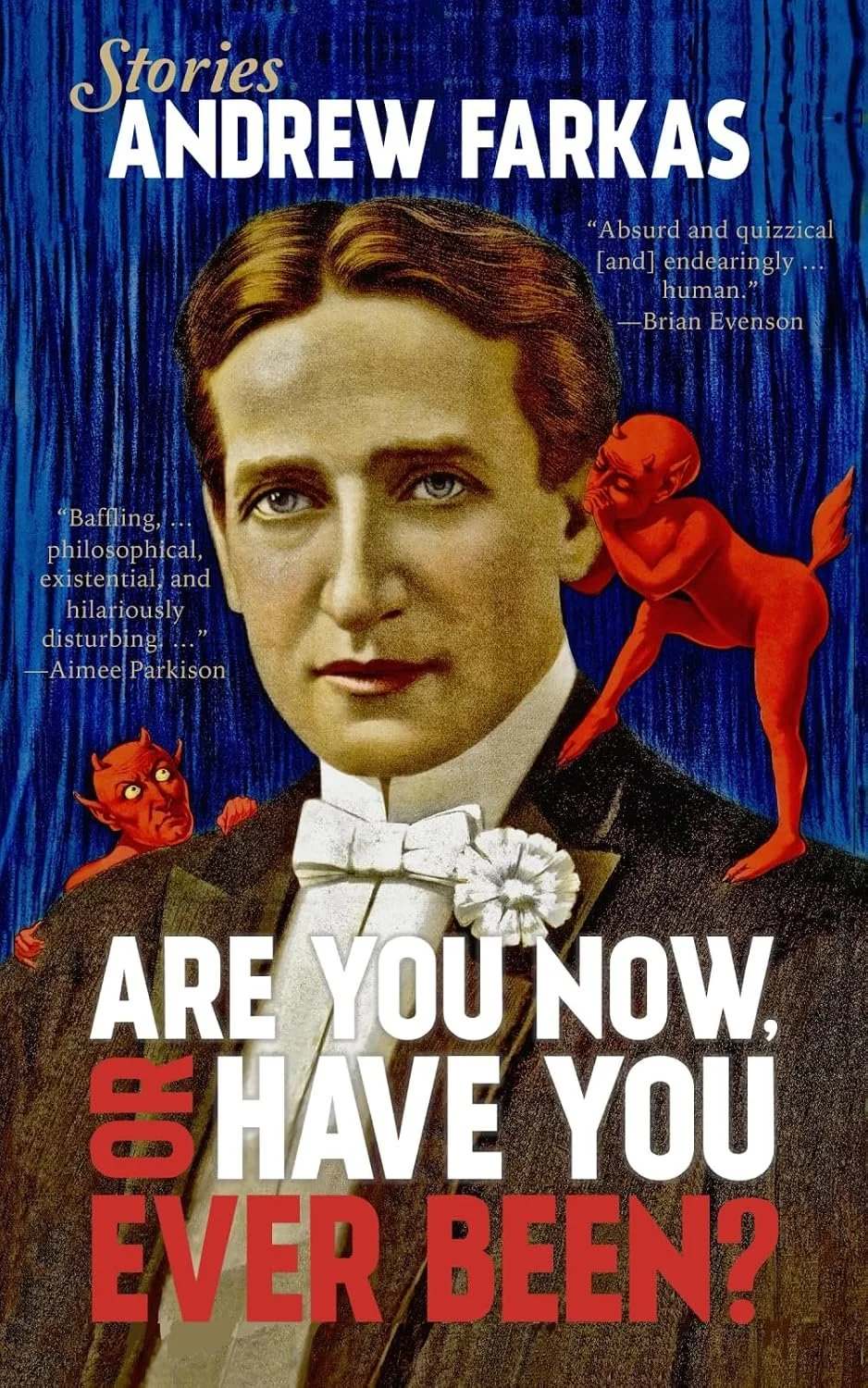
Reviewed by Patrick Parks
Alternating Current Press / February 2026 / 208 pp
Reading Andrew Farkas’s newest collection, Are You Now, or Have You Ever Been, is a little like going to a bar and watching a close-up magician. You think you know what he’s doing, and you’re certain he can’t fool you this time, but then the cup you thought was hiding the red ball is empty, and the king of hearts turns out to be the seven of clubs.
Though it is tempting to continue with the magic metaphor, let’s resist the urge to whip the cliched rabbit out of the hat and consider Farkas’ stories as more than sleight of hand. As Farkas explains in the introduction, this book actually comprises stories first published in Self-Titled Debut as well as a batch of newer pieces, all linked “in some way, about identity, about the difficulty of defining the self, about how we often mistake ourselves for someone else, about the hazards of defining the self too clearly.”
For example, in “Delusions of Nandeur,” Farkas conjures up the familiar image of an institutionalized mental patient in bicorn hat and straitjacket insisting he is Napoleon Bonaparte, and then flips the script so that it’s Napoleon who believes he is someone else:
For all intents and purposes, Monsieur Vizir, I now know I am not an insurance salesman named ‘Bernard Nandeur.’ But from April 1814 to the present, I certainly thought I was. In a way, I still do, although I have been given ample evidence to the contrary. So, whereas I do not feel it, I am convinced this is a case of mistaken identity: I am mistaken about my own identity. But who are we really? Are we who we think we are, or who we are proven to be?
This episode occurs during Napoleon’s first abdication and exile, ending with his return to France in 1815. But rather than playing this reversal for superficial laughs, Farkas presents a transformed Napoleon, one who focuses not on military might, but on the importance of insurance: “Yes, insurance. It seeks the Truth, it finds the Truth, it ensures the Truth. And when no one else knows what the Truth is, the Organization assembles the clues and creates the Truth.”
A second unique take on the world of indemnification and surety and its relationship to self occurs in “Life Insurance,” a Flann O’Brien-esque tale of a man declared officially dead for three minutes who must produce documents to validate his resurrection before he is “buried or burned.” To heighten the absurdity, Farkas gives the narrator a plain-speaking, good-ol’-boy persona that serves him well as he seeks a way out of his fate. Stopped for speeding, he explains to the police officer:
“I’ve got three days’ funeral leave. Wanted to get back home.”
“Funeral leave, sir? Who died, sir?”
“I did.”
“You did, sir?” he said, all sarcastic-like.
“Yeah, look.” Got out the Death Certificate and handed it over.
“How did you die, sir?”
“I don’t rightly know. Just woke up this morning, and They told me I was dead.”
Like the best absurdists, Farkas creates worlds that are self-contained and somehow familiar despite their strangeness. In some cases, he emulates writers who came before, but his nods to them are never derivative. “Timbuktu,” like Donald Barthelme’s “Paraguay,” takes us to a place that shares only a name with the actual location. Farkas’ Timbuktu, not a political state but a vacation paradise, bears no resemblance to its terrestrial counterpart— “Timbuktu is a lone island in an archipelago. Timbuktu is closer than you think” —where the mirage is the draw: “Here, do not think about the past; do not worry about the future. Instead, think only of the present. Of the brilliant shining sun. Of the opalescent waves. Of the bleached, rolling dunes in the distance. Let yourself fade away.”
Echoing influences is clearly homage and not imitation, which adds to the book’s overall delight. In “A Name You Can Trust,” Abraham Lincoln is cast as a hard-drinking private detective and sent out to solve a convoluted, unfathomable, unsolvable mystery. Pynchon gets the nod in this one, but Farkas plays a different game, switching back and forth between third and first person narrators and throwing so many characters and twists at Lincoln that he’s overwhelmed:
Maybe it’s the alcohol, but I get the unnerving feeling that none of this is actually happening; I feel like I’m walking through a haze of memories jerry-rigged together into a nightmare that I can’t escape, a nightmare where I’m searching and searching for something, for an answer, but I only come up with more questions. Gotta be the alcohol.
And in “The Divine Plan: Notes for an Unperformable Mise-en-scene,” Farkas name-checks Waiting for Godot, The America Play, The Resistible Rise of Arturo Ui, Rosencrantz and Guildenstern Are Dead. The parallels are apt, but Farkas takes it a step further. When the piece opens, a stage direction reads: “We open on blankness. Then, from the heavens, God steps down onto the empty stage. (If God prefers to leap onto the stage or float down to the stage, you’d better allow it because, you know, this is God we’re talking about.)” Over the course of 60 entries, a series of observations and orders, the unperformability of God’s performance– available in Farkas’s prose but not in reality–becomes clearer and more muddied simultaneously until it draws down to a single reason: “Because God works in mysterious ways.”
Finding and defining self in Farkas’s stories is often tinged with a comic edge, but “Oubliette” makes the quest a frightening one. In language that evokes a Gothic tale, a businessman steps out into “the type of evening imbued with the spirit of adventure, transforming even the most diehard morning person into a nocturnal animal seeking not contemplation nor rumination, but action.”
The narration sticks close to the businessman as his adventure unfolds, and it hypothesizes that the reader is more acquainted with the world than he is: “Unsurprisingly to you, but a startling revelation to an infrequent perambulator in your town, the businessman stumbled upon a mendicant at the corner of a decaying brick building along the main street.” This blind vagrant—who apparently suffers from Tourette’s Syndrome—is just the first unsettling encounter for the businessman. As the title suggests, he soon finds himself in a claustrophobic darkness:
But panic did not arise in the businessman. For he felt that this is what he always wanted: to be in the dark on an adventure unparalleled in his quotidian life. He groped through the blackness, inexperienced in such circumstances, to the point where the light ceased. It was a hole in the ground.
What follows is a disturbing, surreal journey for both narrator and reader, the latter becoming horrified witness by story’s end.
A much less frightening but no less traumatic story, “Identity Theft,” puts the reader into a situation none of us wants to experience–more than, as the title evokes, the loss of an ID or library card. Perhaps the most overt rendition of Farkas’s intent to get us to examine how we define ourselves appears there:
While you read this, your identity is being stolen, has been stolen. Before you were confident in who you were: you were yourself; before you were confident in who others were: they were themselves. You could not be them; they could not be you. Or so you thought…
But, because this is a Farkas story, the theft of your identity becomes a snarl of circumstances beyond your control, even as you realize it’s your own doing:
Cognizant or no, it turns out that you are very good with computers, that you hacked into various websites containing bank account and credit card and Social Security numbers, that you were able to forge signatures, speak in different voices, even becoming a master of disguise in order to create accounts you would later close; furthermore, you opened several new credit cards in your own name that you operated with the help of a league of associates you’ve never met in order to establish an excellent rating, to replace that entry level plastic with gold and then platinum, all for the purpose of establishing the new you, the you who is not you.
Are You Now or Have You Ever Been is a satisfyingly twisty bunch of stories which, like magic tricks, could go horribly wrong in the hands of a lesser artist. But Farkas is in complete control. It’s easy to imagine him reveling in the reader’s surprise as the pages turnwe turn the page only to find another page. This is a wonderful collection, one that, like the most skilled magic shows, forces a reader to wonder how the man on stage pulled it off.
Patrick Parks is author of a novel, Tucumcari, and has had fiction, poetry, reviews and interviews appear or forthcoming in a number of places, most recently Painted Bride Quarterly, The Millions, Exacting Clam, The Writing Disorder, TYPO, Change Seven, Ocotillo Review, Bridge Eight, Another Chicago Magazine, and Full Stop. He is a graduate of the University of Iowa’s Writers’ Workshop and lives near Chicago. More at patrick-parks.com.