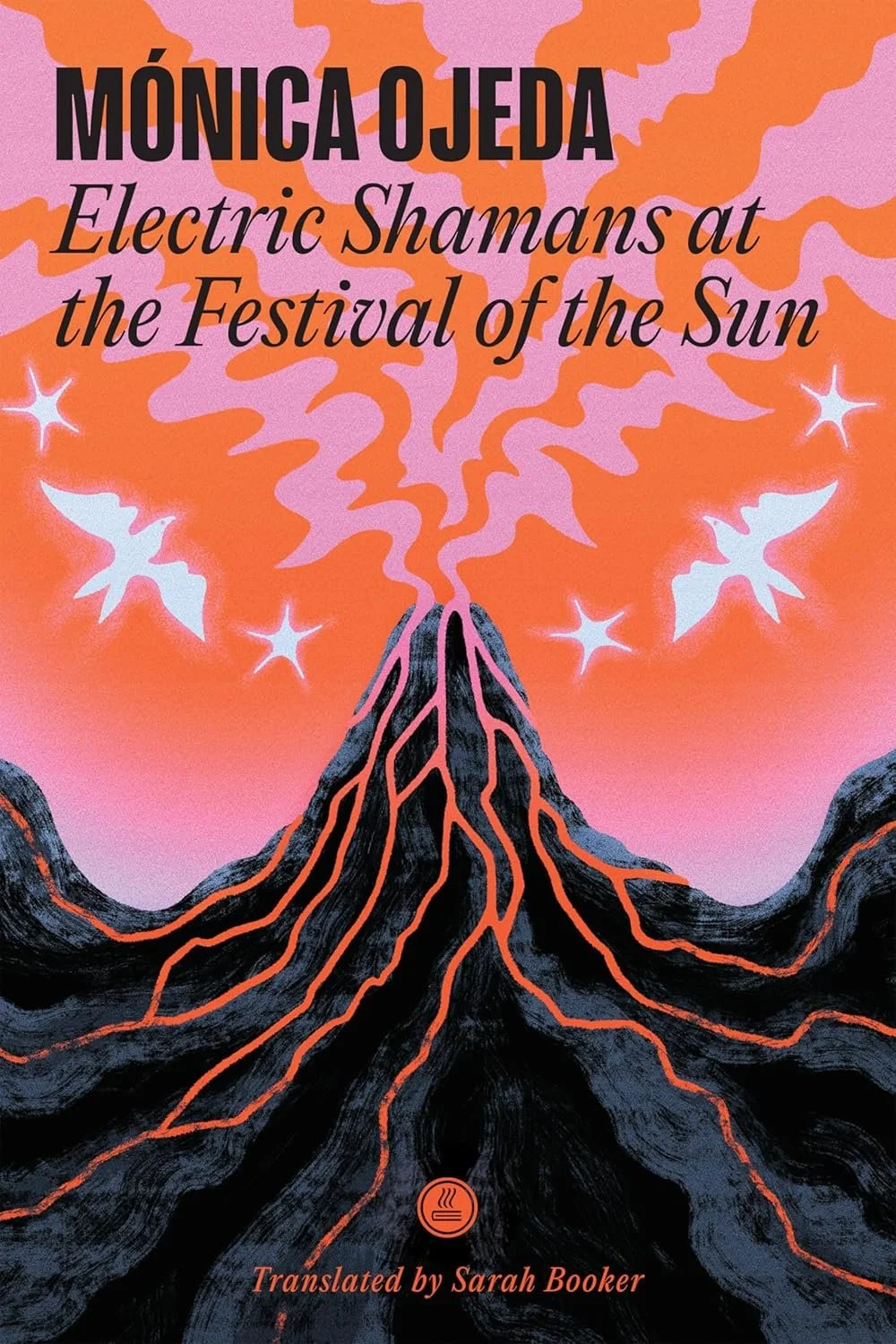
Barrelhouse Reviews: Electric Shamans at the Festival of the Sun by Mónica Ojeda (translated by Sarah Booker)
Reviewed by Ana Hein
Coffee House Press / May 2026 / 240 pages
Mónica Ojeda estranges sound. Across her now three novels translated into English by Sarah Booker, the Ecuadorian horror writer has penned some of the weirdest, most interesting sentences I’ve ever read. Sentences that jump perspectives from clause to clause. Sentences that spiral in on their own syntax. Sentences alive with surprising, disturbing metaphors. Things are always other things in her writing: “To sing is to enter the lonesome night of the breast”; “Every head is a cave that dreams”; “Volcanoes are the tear ducts of the earth!” She is an expert in using the unit of the sentence to show the simultaneous beauty and grotesqueness of language. Throughout her oeuvre, Ojeda positions art as both an expressive and corrupting force, a vehicle of annihilation and ascension for her characters, something at the forefront of her latest novel.
Electric Shamans at the Festival of the Sun takes place during and around a retro-futuristic music festival called Solar Noise. Ojeda shifts perspective between musicians, dancers, performers, and attendants who are fleeing past violences and traumas, only to confront them through the festival’s rituals. Pamela, a drummer, is pregnant with plans for termination after the festival. Pedro, a producer who utilizes interstellar sounds, is deeply in love with his partner and terrified by that love. Mario, a dancer, is trying to channel his rage by performing as Diabluma—his preferred term for Aya Uma, the Andean indigenous figure of protection, who is central in the celebration of Inti Raymi, otherwise known as the Festival of the Sun. Nicole, a runaway, is attending the festival with her best friend, Noa, who seems to be slipping into either a musical/spiritual ascension or psychosis while Nicole tries desperately to ground her. After the festival, Noa wants to find her absent father, Ernesto, but he prefers the silence of his farm, where he hunts and performs taxidermy to connect with God.
This choral, multi-vocal storytelling style is standard for Ojeda. Her first novel translated into English, Jawbone, centers on a friend group at an all-girls school who tell disturbing horror stories, and her second, Nefando, is about six writer-roommates and the disturbing video game some of them created. This form lends itself to Ojeda’s strengths: she explores abstract ideas and interiority through her characters, creating not a sequence of events that build into a plot per se, but a series of interlocking ideas that connect through association and language. Often, these ideas pertain to how art is a vehicle for death, God, expression, nature, enlightenment, and experience itself.
Within Shamans, the art in question is music and its components: instruments, rhythm, singing, lyrics, dancing, sound itself. “A large Noise contingent believed in poetry that gives into the trance, the collective unconscious, and music. They were mystics of rhythm, eccentrics who liked to think of art as a kind of magic that could save us from disaster,” Nicole narrates early in the novel. Each character has their own unique understanding of music, and this creates the harmonies and dissonances that form the novel’s composition.
To Pamela, music is a violent bridge between the bestial and the divine, a link created through the slaughtering of animals to make different kinds of instruments: “[...] but when I heard the sound of my tinya, I understood that not even the sacred or supernatural could be reached without sacrifice.” To Mario, dance is purging of weakness, a bodily embodiment of duality, a vehicle for unification: “We want the eternal, and what we have is dance: a moment contaminated by good and evil, a split second of uniting those who move as one.” To Pedro, everything in the universe is music since everything emits a sonic vibration: “Every microscopic movement is a chord vibration, she said, a song that’s been playing for millions of years. [...] With facts like these, we mixed electronic instruments, sonifications of the universe, and sequenced rhythms. Traditional and modern music, popular and astronomical. Music to dance to and to help us feel less alone amid our vast interstellar solitude.” Even silence has its place within this sonic landscape, as Ernesto believes that “Silence makes space for a sincere, generous language, one that needs no one, only God.”
Much like the music festival at the novel’s core, Ojeda merges multiple artistic traditions to synthesize a new literary experience. She blends Andean indigenous spiritualism, poetry, music history, horror, and bildungsroman into a remix of text. Hers is a lush, disquieting voice, frequently reading like the drug trips the novel’s characters are on. Her writing embodies what she writes of: an evacuation and connection with the self, a concentration and exorcism of emotion, a crucible for intensity.
“To have a voice is to be alive and kicking, and to be alive is to rejoice and suffer. We sing because we suffer and rejoice,” Ojeda writes in one of her more lucid sentences. Electric Shamans at the Festival of the Sun—and Ojeda’s work on the whole—blends that suffering and rejoicing to expose what art is, and what it makes of us. All it takes to feel such intensity is to listen to her words.
Ana Hein is an essayist and critic. Her work has been featured in Electric Literature, The Rumpus, AFM, Digging Press Journal, Mothership, Compulsive Reader, and Videodame, among other publications. She holds an MFA in nonfiction from Columbia University. Currently, she lives in Poughkeepsie, New York. You can find her at anaheinwrites.com.