
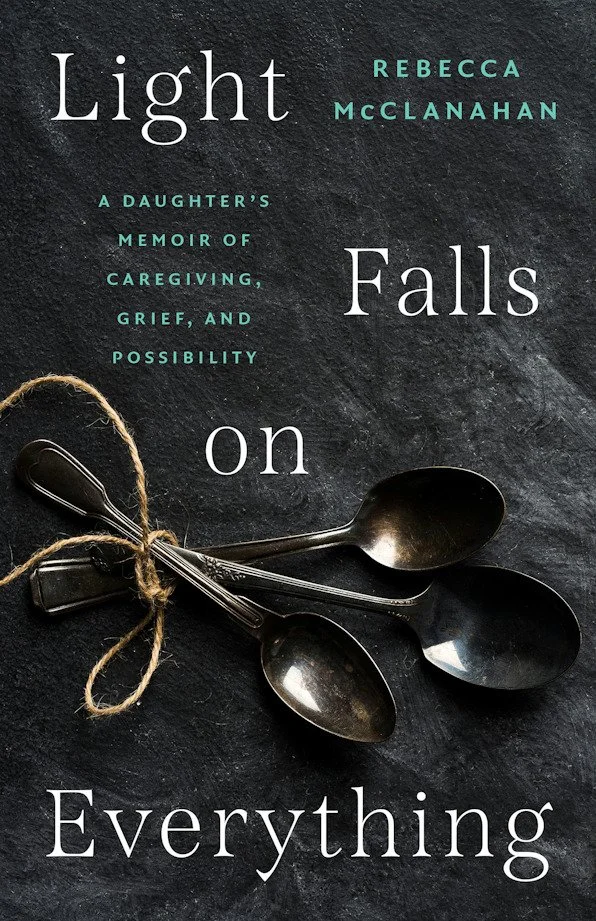
Barrelhouse Reviews: Light Falls on Everything by Rebecca McClanahan
Reviewed by Amy Wright
University of North Carolina Press / March 2026 / 272 pages
Rebecca McClanahan’s eleventh book and fourth memoir, Light Falls on Everything offers instruction not only for romantic but also familial love, as indicated by the subtitle, A Daughter’s Memoir of Caregiving, Grief, and Possibility. “This is not a how-to guide,” though, she warns in the prelude. She knows better than to presume a formula will help others; she presumes only that her readers, too, will have a caregiving story given enough time and loved ones. She shares her story in hopes that it, “however different from your own, will be of use to you.”
Call it McClanahan’s bar-raising work ethic that prompts this practical value. Readers familiar with her writing will recognize a spirit of generosity and determination from her multigenerational family memoir, Tribal Knot, which traces her ancestry through the letters and journals of hardscrabble Midwest farmers. As in that book, the real story in Light is McClanahan’s character, her family’s character, and the development of human character generally, through trials and perseverance, which, like the earth making a diamond, press jewels between them in enduring expressions of love.
In recording her parents’ final years and the decline of her mother into dementia, McClanahan’s latest memoir offers her greatest intimacy yet. She imagines this book as “a handwritten letter” sealed and mailed directly to readers, who might turn to it for comfort as they, too, encounter love and loss, individually.
This letter begins with the narrator walking in on a tender moment. McClanahan’s mother, eyes closed, stretches out on the sofa with her feet in her husband’s lap. He looks up with pride and mischief in his eyes, caught in this gesture of affection. To fully appreciate his feeling, though, readers need the context revealed in paragraphs that follow. Just the night before, her mother, Juanita, had called McClanahan in a panic, screaming that there was a strange man in her house. After rushing over and spending an hour reassuring her that this stranger was in fact her husband of more than seventy years, McClanahan had convinced Juanita to return to bed with him.
In a lesser writer’s hands, such illustrations of the indignities of aging might tilt pitiable or burdensome. In McClanahan’s, descriptions of these realities indicate the strength it takes to face them. Her power as a writer rises from the same maturity that helps her and her siblings convince their parents, in their 90s, to move from their beloved Indiana home to North Carolina so they can continue to live together. McClanahan and her husband of forty years live next door, so they serve as “first responders.” This training in compassion and filial duty fortifies them to meet the demands of any love that lasts a lifetime. By sharing their witness, in anecdotes that are by turn bittersweet and funny, she offers readers a chance to fathom the depths of commitment and behold life’s daunting array of gratifications and challenges.
In one example that “has long been the stuff of family lore,” McClanahan portrays her young mother decades before dementia changed Juanita’s character. It was 1955, and her husband “had been home from an overseas deployment for several months.” His visibly pregnant wife sits in the kitchen feeding their one-year-old daughter, Claudia. Taking this scene into account with knowledge of their three previous children ages four, seven, and eight, her sister scolds, “Juanita, how could you let this happen again?”
“I’m just always so happy to see him,’” Juanita tells her sister, smiling. Her answer charms readers by revealing another facet of this multifaceted character. McClanahan does the same justice to the other family members featured in this memoir, including her father Paul, her husband Donald, and her grandparents. Their legacy of love lives on in this memoirist who opens her life to the page with a keen eye and the wisdom, wit, and vulnerability to depict how complex character is forged.
Divided into three acts (the early, middle, and final years, with an interlude, prelude, and postlude), Light unfolds in layers that made me laugh with tears in my eyes. In one chapter, we sit at the dinner table, watching a mother mistake her daughter and son-in-law for neighbors. In the next, we visit an Indiana farmhouse where a goat named Billy has just turned the air “blue with cursing” by escaping the barn and standing at the foot of McClanahan’s grandparents’ bed “chomping on the covers.” This near-slapstick anecdote catches us off-guard, as life does, in moments both tragic and comic. Drawing humor and hardship together throughout this book, McClanahan exercises the heart’s potential to surprise us when we face difficulties of our own.
Light offers a playbook of lives burnished by sorrow and sweetened by fondness, which reminds us that caregiving begins before birth and continues beyond death. It shows how a memory shrouded in darkness can illuminate a family and bring the landscape of a long marriage into sharp relief. And it encourages us to understand that even the most dreaded circumstances ripple with potential intimacies and revelations.
Amy Wright has authored three poetry books, six chapbooks, and a book of nonfiction, Paper Concert (Sarabande Books), which received a Nautilus Gold Award for Lyric Prose. Her work has also been recognized with two Peter Taylor Fellowships to the Kenyon Review Writers Workshop, an Individual Artist Grant from the Tennessee Arts Commission, and a fellowship to the Virginia Center for the Creative Arts. She joined ETSU’s faculty after serving as the 2022 Wayne G. Basler Chair of Excellence. Her personal essays and poems appear in Brevity, Fourth Genre, Georgia Review, Kenyon Review, Ninth Letter, and elsewhere.