Barrelhousing with Kurt Baumeister, Author of Twilight of the Gods
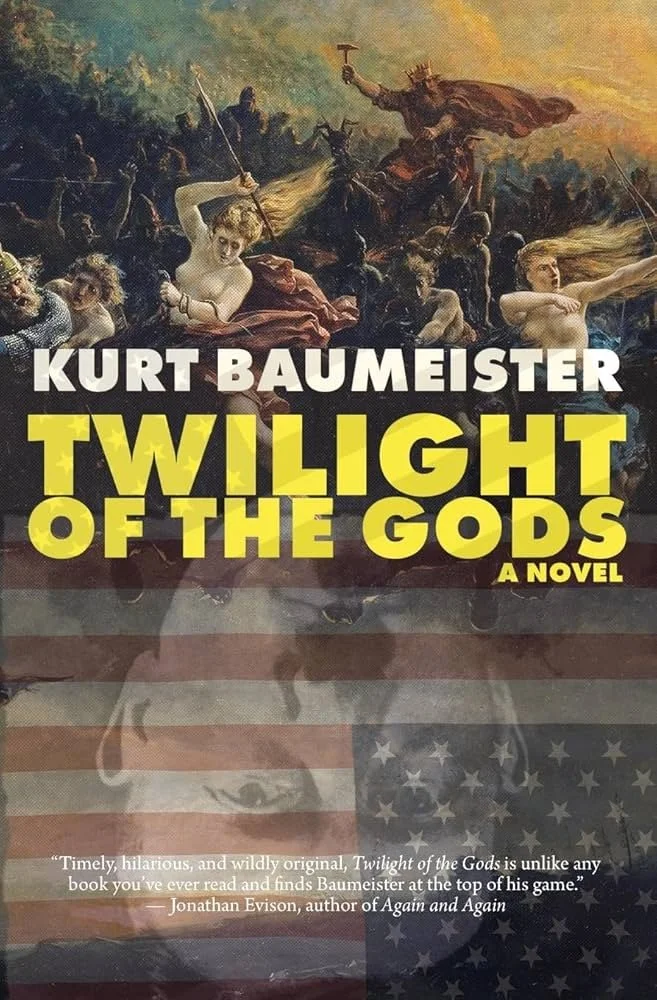
Kurt Baumeister’s Twilight of the Gods is bonkers in all the best ways: irreverent, cinematic, epic in scope, funny, scary, mischievous, and very timely. The book reimagines the mythology of the Norse gods in the modern day, still reeling from the fallout of Odin’s ill-fated alignment with a young Adolph Hitler in the late Thirties. The word “Reimagines” is possibly not strong enough here. Baumeister is, as mentioned below, fucking around with Norse mythology, and having a hell of a time while he’s doing it. We sat down around the old email machine and talked with Kurt about Twilight of the Gods, Norse mythology, and of course Patrick Swayze movies.
Barrelhouse: I always start these in a pretty simple way: What made you want to write a book about Loki and the Norse gods?
Kurt Baumeister: One thing that’s always intrigued me about the Norse myths is how different they are from the Greco-Roman myths in structure. While the Greco-Roman myths feel more disconnected, episodic, there’s a clear dramatic arc to Norse myth, a series of apocalyptic events that build towards a definitive climax, the Twilight of the Gods. Scholars have considered the idea that this may result from syncretism between Christianity and Norse myth; that the co-mingling of the two religions may have led the Norse religion to develop the same sort of apocalyptic conclusion offered in the Christian Book of Revelation, another bit of mythology that’s fascinated me over the years. Maybe I’m desperate for the ordered universe implied by these mythologies? Maybe I just love big, bad, shoot-em-up endings? Or, maybe they’re really just the same thing?
BH: Twilight of the Gods. A good name for a book! From your answer above and the fact that, you know, you wrote a whole book about the Norse myths and the characters in them, I can tell that you’ve got a real authority with this subject matter, which is obviously the foundation you need if you’re going to start fucking around with them (and I mean that in the most complimentary way!). What’s your relationship been to the Norse myths? Is this something you were always interested in growing up? Was there a particular moment when you did a kind of deep dive into the mythology?
KGB: Alright, so, a few thoughts…
First: I am reminded of Martin Amis’ Note to London Fields in which he says he considered multiple alternate titles for that book, even giving up one he loved, “Then I thought Millenium would be wonderfully bold (a common belief: everything is called Millenium just now).” I guess I sort of wound up doing the opposite of what Amis did. This book’s original title, The Book of Loki, isn’t in nearly as wide use, if at all, but when I got closer to the end and started thinking about changing the title to Twilight of the Gods, a famous phrase in its own right, I knew this new title was just too perfect for my book, even though others were using the same title for other books, TV series, etc, etc. Second: “Fucking around” seems an entirely apt description of what I do, so I’ll take it, with thanks. Finally, my answer to your real question…My first exposure to Norse myth came in the back pages of Edith Hamilton’s Mythology in, perhaps, sixth grade.
I have read different source books over the years, but the one I’ve made most use of is The Norse Myths by Kevin Crossley-Holland. The great thing about Norse myth, and Crossley-Holland does an exceptional job of pointing this out, is how it evolved over quite a long period of time, so much so that the stories we see as “canonical” come from different traditions and even appear in different forms in different compilations. And, of course, there's the issue with Christian syncretism again. It’s hard not to see Loki’s final form as satanic, but that character really evolves over the course of the stories. Sometimes, particularly early in the story cycle, he’s considered a friend to the gods or even kin, others a trickster or a “low-key” (pun not intended but I’ll let it stand) enemy. By the end, at least in traditional tellings, Loki’s definitely the Big Bad.
BH: You’re so clearly having fun with these texts and characters. I’m curious: What was the seed that got you started?
Thank you! This seed of Twilight of the Gods is an unpublished (and only partially completed) short story called, “The Norse Gods Go Skiing.” The action is set in a trusty family station wagon on the way to a ski resort. Odin and Frigga are in the front seat, tweens Loki and Thor are fighting and screaming and generally warring in the back. I think maybe the Fenris Wolf is in the cargo hold or whatever they (we?) call the very back part of a station wagon. As they get close to the resort, Odin tells Loki he has to hide in the cargo hold with the dog because Loki’s a shitty skier and Odin doesn’t want to pay for him or some such thing. Loki slips away at the entrance to the resort. Mayhem ensues. And, right…this bears little resemblance to Twilight of the Gods.
BH: I can definitely see how this would be the seed for Twilight of the Gods, though! If you had said “The Norse Gods as a dysfunctional family” I think that’s right in line. Of course the scope and scale of this book is a heck of a lot more than Loki hidden in the cargo hold of a station wagon. The Stalking Horse site describes the book as “satire and alternate history on an operatic, cinematic, and cosmic scale, with a cast that transcends time and space,” which I think is a very accurate description. As a writer who is currently struggling off-and-on with a first draft, and just kind of dragging a few characters from place to place to try to make a very simple plot work, I’m impressed by the scope of your book. Did you always see it as a kind of epic tale? And on a practical level, did you outline this, or did you more or less make things up as you went along?
I haven’t had much luck with detailed outlines in the past. I do write them, but can’t bring myself to stick with them. I suppose I feel like plots and stories have to evolve on the page. I think the end of Twilight of the Gods is a good example of this. Some of the things that the character Kurt says to Loki point to how I see the dramatic arcs of novels or stories or whatever. It’s about what’s “right,” what works for the author. In this, it’s a bit like fate, though it’s fate imposed by the author, a petty god to his or her own book.
With the book’s ending, for example, its final form changed near the end, and I was really happy with how it came out. When I get stuck, which happens at least several times with each book, what seems to help me is to describe the plot or story or whatever I am having trouble with to myself in writing. I call this freewriting though I’m not sure the term is really apt. Who knows? Perhaps this is just what others get from outlining in a different form.
BH: Obviously there are some pop culture comps for the book – I’m thinking primarily of the TV show Loki, which I should probably mention that I’ve never seen, but even so, I know that the show is an extension of Loki from the Avengers movies and the MCU in general. Also the book and show American Gods. Did you think at all about your book in conversation with these other pop culture entities?
It’s fine that you haven’t seen any of those pop culture touch points. There’s no intentional correspondence between them and what I have in Twilight of the Gods except to mock them maybe. Which shouldn’t be construed as saying I don’t like them. I like Tom Hiddleston’s Loki. I like comic books, too. And I liked the adaptation of American Gods–well, the one season I watched I liked. As for Gaiman’s book, American Gods, I did read it once perhaps ten years ago. I’d describe it as really good. There are just so many great ideas. Unfortunately, in terms of his line-level writing, I think of Gaiman as upmarket/genre so I found myself wondering what a literary writer might do with the material. I’m not saying I’m that person, but I tried. Ultimately, my goal with Twilight of the Gods was to avoid these other touchpoints as much as I could because, well, plagiarism, right?
In the book, Germany is on the brink of an election, with a right wing candidate who threatens to return the country to its worst authoritarian days. The Gods, and especially Odin, have a history with this, having thrown their lot in with Hitler in World War Two. I guess just logistically, when were you writing the book? Could you see what was going to happen here with the last election? I’m curious about that part of it, I guess very morbidly so at this point.
The scenario in the book’s Germany and the way it ultimately lands in America concern Trump for sure. But it’s more about the 2016 election and the totality of Trump than current events. I really didn’t think he’d win as I was writing it and especially when I delayed the release to do another draft, I thought I was damaging the book’s marketability. I didn’t think people would be interested in Trump anymore after he lost (again) in ‘24. (Shame on me.) Not that the question of whether the book was going to be “marketable” really mattered to me. I also wanted to set the political “action” in Germany in the hope that America might take a fresh look at itself; you know, that we might be able to see ourselves the way others do.
Okay our last question on every Barrelhouse interview: what’s your favorite Patrick Swayze movie?
That’s a tough one. I’m not sure this is a movie but I sort of have a soft spot for North and South, the Civil War miniseries. As for proper Swayze movies, definitely not the big ones (Ghost or Dirty Dancing). I enjoyed The Outsiders, Red Dawn, and Road House; but I’d have to say my favorite is his epic pairing with Keanu in Point Break. My first novel, Pax Americana, has a whole thing with the villains wearing presidential masks at times, and it’s hard to imagine Point Break wasn’t knocking around some part of my brain as I was writing that.