
Barrelhouse Reviews: Sympathy for Wild Girls by Demree McGhee
Reviewed by Jeffrey-Michael Kane
The Feminist Press / May 2025 / 216 pp
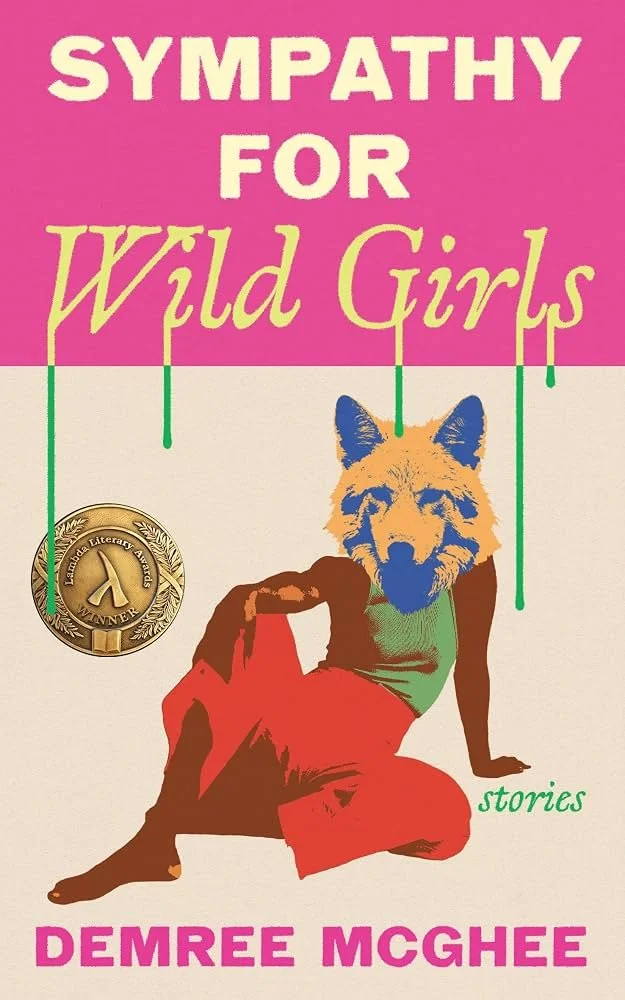
IIn the title story of Demree McGhee's debut collection, a young woman named Daisy cannot stop thinking about dead girls. Her mother has told her how to stay safe—"don't go anywhere silent and gentle; leave marks, bite marks, claw marks, anything that can be evidence later"—but the warnings feel less like protection than prophecy. Daisy thinks of every pair of eyes that could have ever possibly raked across her body. She stops washing. She avoids eye contact. She tries to make herself undesirable, to inspire disgust rather than interest, and when that fails, she runs away to live with a pack of wild coyotes. The story is told with the matter-of-factness of a fable and the specificity of a case study, and it announces McGhee as a writer whose formal intelligence is inseparable from her emotional urgency. The fifteen stories in Sympathy for Wild Girls follow queer Black women as they navigate a world that is "subtly warped"—McGhee's phrase—in ways that are sometimes fantastical and sometimes simply true. The coyotes are real. The violence is real. The line between them is not always clear.
The collection's central achievement is tonal. McGhee writes in a register that moves between the surreal and the documentary without announcing the transition. In "A Matter of Survival," the phrase "men are dogs" appears to be literal; a father dispenses coins from his mouth, and his daughter inherits the trait. In "She Is Waiting," a woman who was kidnapped as a child must load her pockets with rocks to keep from floating away after a traumatic event. Her grief has made her weightless, and she must anchor herself to the earth. In "Thinning," a former student athlete becomes obsessed with her body, her gym routine, and her caloric intake. McGhee tracks the obsession with the same clinical attention she brings to fantastical stories—the realism of disordered eating rendered as strange as floating. These details arrive without fanfare; they are simply the conditions under which the characters live. The effect is less magical realism than magical naturalism—a world in which the strange is not an intrusion but an extension of the real, the way grief or desire can warp perception until the metaphorical becomes physical. McGhee has cited Toni Morrison and Audre Lorde as influences, and the lineage is visible: she writes about Black women's bodies with the same unsentimental attention to what those bodies are made to carry.
The stories are set mostly in California, and they range from the contemporary—big-box stores, social media influencers, gym culture—to environs more timeless and fable-like. "Be Good" follows a runaway who changes her name to Jane and moves in with a trio of white Christian YouTubers, only to discover that their piety is a performance and their sins are real. Among women who are terrified of their so-called sins being exposed, Jane decides that this new life she has made is only worth living exactly as she wants to. "Valerie" chronicles a woman's mission to have her first orgasm from another person's touch; a "sexospiritual" healer gives her a tea meant to release her "tamped down" desire, but it only makes her uncomfortably hot. "I'd rather be a fake bitch than a sweaty bitch," she reflects, and the line, while funny, does not diminish the longing underneath. McGhee's humor operates like this throughout the collection: it arrives in the middle of difficulty, without announcing itself, and it makes the difficulty more bearable without pretending it is not there.
If there is a weakness, it is structural. Several of the stories feel less like complete narratives than fragments of larger works—gestures toward a theme rather than full explorations of it. "Exchange," about a pair of shoplifters who are caught by a woman who gradually works her way into their lives until she replaces one of them, has the bones of a novella compressed into a short story; the compression is sometimes generative, but here it leaves the ending feeling abrupt rather than open. A Kirkus reviewer compared McGhee's stories to shards of a broken vase—"enticing to look at and touch"—and the metaphor is apt: these are pieces that cut, but they are also pieces, and the reader sometimes wants the whole vessel. Yet the ambiguity is not accidental. McGhee’s endings remain intentionally unresolved but still emotionally effective—she refuses to tie things off precisely because the lives she is describing do not tie off. The woman who floats does not stop floating. The girl who runs to the coyotes does not return. This is the risk of genuine ambition, and McGhee's ambition is evident on every page.
Among the collection's finest stories is "Scratching," which follows a school nurse named Lena whose grief over her girlfriend's death leads her into an inappropriate relationship with a student. The relationship is not sexual; it is something stranger and, in its way, more disturbing. The student is obsessed with dead animals, and Lena begins to help her collect and preserve them, to bring them back in some form. The story tracks Lena's growing detachment from reality with clinical precision, and it never lets the reader off the hook: we understand why Lena does what she does, and we understand that understanding is not the same as approval. McGhee depicts the way grief climbs into your bones and reacts chemically with the core of who you are. The story is profoundly unsettling, and it earns its discomfort through craft rather than shock. This is the mode in which McGhee works best: the horror that emerges from love, the violence that is inseparable from tenderness.
Sympathy for Wild Girls has drawn comparisons to Carmen Maria Machado's Her Body and Other Parties, and the comparison is earned: both collections use fabulist techniques to explore how women's bodies are sites of danger and desire. But McGhee's register is her own. Where Machado's prose tends toward the ornate, McGhee's is spare and declarative; where Machado builds to revelation, McGhee often withholds it. The unresolved endings that characterize several of these stories are not failures of craft but refusals of false comfort—a formal acknowledgment that the world does not resolve, that desire remains dangerous, that the feral is sometimes the only refuge available.
Jeffrey-Michael Kane writes from New Orleans where he works as an attorney. He is the author of the non-fiction book Quiet Brilliance: What Employers Miss About Neurodivergent Talent and How to See It (CollectiveInk UK). His essay, “Nomenclature of a Life”, cataloguing his experience as an ASD-1, was awarded the Ellis Prize for Non-Fiction (New Ohio Review). His writing has appeared in cultural, theological, and literary journals that appreciate compression—and his willingness to obey word counts.