
Barrelhouse Reviews: Is Is Enough by Lauren Camp
Reviewed by Margaret Lee
TRP: The University Press of SHSU / February 2026 / 86 pp
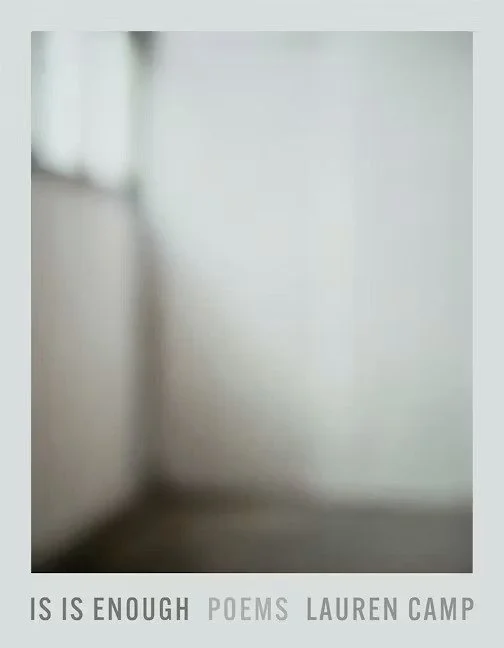
In the middle, there’s a party and a car wreck. Blood-blossoms adorn a father’s head. A remembered childhood trauma following a family celebration becomes a microcosm for the subsequent journey through a father’s dementia and physical decline. Images of beauty and trauma intertwine throughout Is Is Enough: Poems by Lauren Camp, award-winning poet and former poet laureate of New Mexico. The book’s title hints at the story’s resolution: total acceptance of the fact of existence.
“Smeary Flowers, 1983” narrates the car ride home from an uncle’s second wedding, When the frame of our car/stapled its metal to the side/of another. The poem depicts each moment of the event in ambivalent terms, beginning with a child’s fatigue: All I wanted was the haze of a worn gown/of sleep after the scrape of that/honey-sipped night.. The accident seems inevitable: Something needed/breaking. My soft wrist/on the reed of my arm. After the impact, Blood glistened/like buttons from a gash in her father’s head in a shower of smeary/red flowers. In the hospital aftermath, the poem’s speaker realizes, That night/was never bent on farewell. It continued, long past the ride home in the ever slippery/dark, cascading through windows. The father’s injury prefigures his death, and the speaker’s subsequent adult experience of a long farewell reverberates with the foreknowledge, suffering, and inescapable darkness that mark this childhood memory.
Resources from Camp’s prolific career as a visual artist, ecopoet, and searcher for meaning equip her well to examine an aging father’s memory warped and perforated by dementia. Startling juxtapositions, spare punctuation, and dangling dependent clauses replicate for readers the chaos and alienation that father and daughter endure. These trademark techniques suit Camp’s subject. Is Is Enough plunges readers into a swirl of detail, requiring them to make sense of it, just as the daughter must in her passage through her father’s illness. With “Harmony,” the book begins:
Train stops and eggplant and the grim little sun and our clapping
all morning and later we slicked down to righteous
dance moves, pink greasy boxes of dough.
The father’s slow unwinding suggests uncertainties of the past and the future’s fragility. “His Kingdom of Brooding” describes the father’s alienation in his residential care facility:
He named objects and light.
Each hour he saw different afternoons in panes of wide rectangles.
He called me dear, which was a shimmer.
The eggs came all runny, with biscuits.
And he made it clear he’d never take part in the singing
though he’d voice the familiar rhythm of anger.
Correlatively, the daughter enters her own struggle as she adjusts to her new role as caregiver. Anger and desperation well up in both father and daughter. “Our Daily Ration” depicts the parallelism. The poem’s speaker describes both situations in terms of laceration:
I slice celery for the crock pot. Sigh in near perfect pitch
and my articulations verge on defiance.
I am now only chopping up silence, moving the small
pieces into a bowl.
…
… Each day returns
with the thin exact blade
of my father’s voice. What has been cut
from what he had yesterday. I stir the soup with a pine spoon.
In “Reclaiming Perspective,” memory and time reemerge as visions that register with onlookers: Sometimes his old city creeps over his face. The speaker declares, I wanted to wake knowing/that the dark hadn’t held him/at knifepoint. Eventually the realization dawns,
Nothing is insignificant, but I know the room
holds all his history. There’s no doubt he’s dipping below
membranes….
The speaker ultimately concludes, His brain is dismantling,/but he isn’t waiting. His identity is not where he left it.
Throughout the process of decline, Camp resists solipsism by recognizing universal dimensions of the father’s and daughter’s shared dilemma. The poems’ speaker looks forward as well as inward (from “Prognosis”):
… We are spending
our time folded
into it, finding
ourselves. We are not
doing nothing. We are planning
the task of letting go
of all thought and my father is root
and tree.
In “Whether or Not or Neither,” the speaker depicts this universal dimension by noticing another resident of the father’s care center:
… I saw her eyes
find the surface and the pattern
of tragedy, which is in me, in you, the drain
of so much reason,
and the relief of more tears.
Nor does this outward gaze place the speaker above the fray at a remote level of generalization. The intensity of the daughter’s personal journey sharpens her perception of others’ hardships and the environment they share. “Train of Thought” narrates an uncanny awareness of a passenger on a commuter train against the landscape scrolling by outside the windows. The poem describes both the woman and the terrain in terms of skin, the membrane defining the body’s boundary and the land’s surface available to view—tissues that the speaker reads like a book. The surprising juxtaposition of skin and reading unifies the poem and situates speaker, subject, and landscape in a compassionate tableau.
Placing struggle against a landscape is another trademark of Camp’s poetic style. The mundane yet disorienting task of clearing the father’s apartment, his panoramic/past, exhibits this sensitivity to place. The poet’s oeuvre situates precise, interior details and the speaker’s emotions against a larger backdrop of the external environment, as in “So Much to Reduce”:
We’ve got three rooms and three days to garbage
or fondle the traces.
…
… His many shampoo bottles
fill me with loneliness. I won’t leave this jungle
of items. Down below us, Philadelphia’s streetlights
chalk with white, and the bridge grins
brightly against flowing water. My father built
his pleasure and strength from that river
and hummus and meaningless words
and his endless complexities.
The poet intuits that something more than memory holds lives together. After taking 48 photos of shadows in quick succession, the speaker confesses,
… I deleted them
from my memory which wanted not to hunger
for these compulsions, statistics. We were taught
so many instances to doubt, but the light came along
singing and we joined it, taking its melody as apology.
Seeking something beyond these compulsions, statistics of a life, “I Pull into the Walgreens Parking Lot” hints at what lies beyond memory:
… That’s why I’m in a parking lot
holding my hand in my tired hand & saying
love, the word stuck to my palm. This teaches me
not to hurry and this is not enough. Love, love
& again the traffic light burns up with red. The sky falls
toward night. Saying it in every available absence.
Love, the speaker’s anchor and talisman, soon becomes redefined in “Elegy for the Routine”, the longest poem in the collection. A single, seven-page stanza spools out the father’s unraveling as his mental and physical capacities diminish. The poem’s unsubdivided length requires the reader to share the panic that lurks in the relentless stream of disintegration.The speaker confesses, Love is each/complicated sadness.
Finally, the end comes. In “Parties,” the speaker explains, On Sunday, I wrote the obituary….I built him a legend:/column-length, tight. Sort of true . Somehow, Camp finds heartbreaking beauty, even in the last good-bye:
… How could we leave, but
we did—north to the cemetery
to see the last of our father. To call love
unbearable and cry to the earth, then come back as the plum-
colored sun dipped down, seaming its diligence, handing off
hope to the neon. And we saw the city
muffle such emptiness with its own grand expanse.
Camp chronicles each stage of the father’s decline by focusing on the inextricability of beauty and pain. Her poems mine subterranean intersections of life and death with profound insight into the heterogeneity of memory: it preserves joy and sorrow equally because they are inseparable. A flinch from affliction obscures delight, while bliss-blindness degenerates into horror. Remembering means facing it all. Camp trains a deliberate gaze on memory in its wholeness, achieving a compassionate view of both the remembering daughter and the father whose memory falls prey to dementia. Is Is Enough endows the primal struggle of death with the dignity and grace that characterize Camp’s creative vision. Readers who know the struggle will find beauty and truth in the telling.
Margaret Lee is a poet, scholar, fiber artist, watercolor sketcher, and aspiring naturalist in Tulsa, Oklahoma. Her book reviews appear in American Poetry Review, Compulsive Reader, and Taos Journal of Poetry. Her poetry collection, Sappho Prompts with Finishing Line Press, uses Sappho’s fragmentary lines as prompts for new poems exploring the myths, desires, and longings that characterize Sappho’s ancient songs. Margaret’s previous chapbooks with Finishing Line Press include Someone Else’s Earth (2021), Sagebrush Songs (2022), Oklahoma Summer (2023), and Orange Persephone (2025). Her poems also appear in From Behind the Mask, (Paperback-Press 2020), Echoes of Tradition: Indigenous Orientation to Community, Time, and Land (Tulsa NightWriters 2024), Atlanta Review, eMerge Magazine, Okie Modern, and Pangyrus. Margaret earned a B.A. in History from Seattle University, Seattle, WA; an M.Div. from Phillips Theological Seminary, Tulsa, OK; and a Th.D. from the Melbourne College of Divinity, Melbourne, Australia. Her academic research and publications focus on the ancient Greek language and the history and culture of the ancient world. Her website is margaretleeauthor.com.