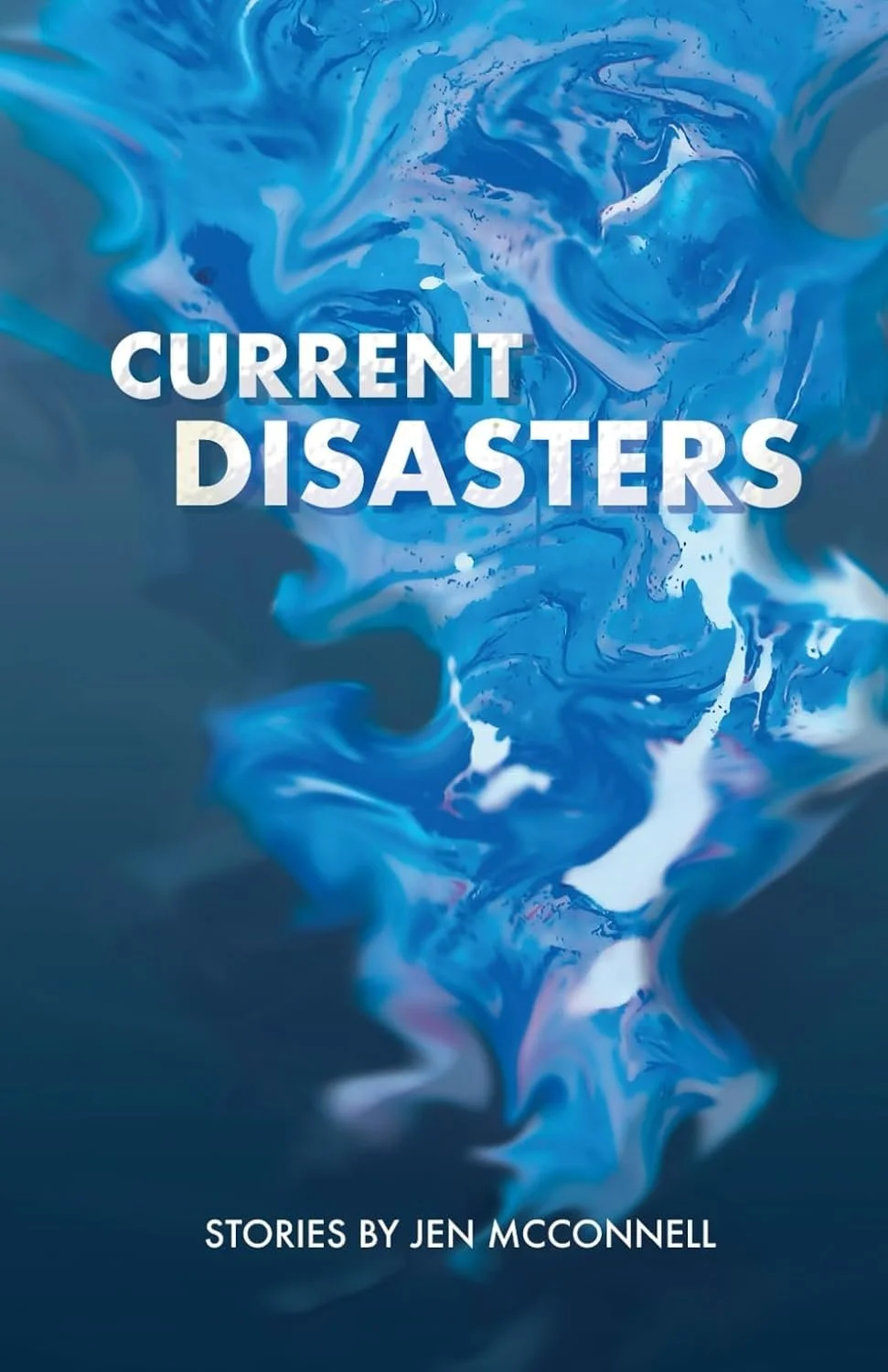
Barrelhouse Reviews: Current Disasters by Jen McConnell
Reviewed by David Waite
Roadside Press / May 2025 / 100 pp
In Jen McConnell’s Current Disasters, the absurd looms just as large as dread or joy or understanding. The twenty stories, some medium-sized and some only a paragraph, often have a shattering absurdity, but equally often, they offer ridiculous and damn fun adventure. When, for example, the nameless narrator of “Not the Worst Day of Your Life but Definitely Not the Best” climbs into a cheap display coffin, it feels both natural and a stupid decision, compelled by restlessness. At other times, the irrational is a hard and fast rule of the universe but we get to see it in a new way. Who hasn’t experienced a piece of art that makes us want to babble, standing in the street? Who can’t relate to the silly, cloying names people give their dogs? Who doesn’t want to eat greasy quesadillas at midnight with someone you love, speaking without speaking because “eating together in silence is enough”?
Many of the stories are on a knife’s edge of excitement or anticipation or disaster, even when there’s a gentleness to the chaos. In “The Irrational Constant,” a teenager walks through the annoyances of two homes, the demands of school, and ill-fitting friends all while trying to memorize enough digits of pi to win a school contest. Who would ever want to be sixteen again? Imagine the mindset where someone would say, “I wished I could go to a math camp or bring myself to fail a class so I could be assigned summer school.” And pervading the story, there’s a fever-flush in her face that everyone can see. Uncertainty suffuses the piece and its ending, but the reader’s connection to McConnell’s character has been formed. And what do the irrational and the constant really mean here? The story lingers and pushes gently.
Other stories are focused micro-fiction, just as fully realized in their effect and emotion. In “All the Kids Are in Therapy” a jagged sense of realization and blame and lack of control spills out of the rambling voice of the narrator. As the single sentence continues, the reader starts to judge and forgive this person and also, frankly, get a little annoyed at them. There’s so much inside this person’s life to imagine. Revelation shows up too; it’s an entertaining story, and also a lesson in voice and intuition.
McConnell’s style and delivery are often bare-bones, and blessedly so. In one scene from “Worry, Incorporated,” a curious office worker at a seemingly bullshit job follows the owners’ granddaughter around. When the two women converse in a diner, one doesn’t need to know what the room looks like because the conversation offers all one could need and want, even if one doesn’t know whether to believe it—it’s the truth for one conversant but perhaps not for another. At a pseudo-scientific, vibe-oriented corporation where employees worry for their clients so the clients don’t have to, when this lone office worker finally asks questions, the answer is both a cipher and a riddle: “Because they pay us to worry, they believe it works. The more worries they unload onto us, the better they feel—like they’re getting their money’s worth. Whether we actually worry or not is irrelevant.” Then why has the office worker been doing the worrying in the first place? We believe what we believe, which is an echo of the story’s conundrum: what do we do to soothe ourselves, even if it might be nonsense?
I remember people, impressions, and sensations from McConnell’s first book, Welcome, Anybody, and those feelings and characters still pop up in my life. The personalities in Current Disasters are just as vivid: the one-armed actor, the “lucky” old-man newlywed, the sick man going home to face the past, the polar researcher who accepts her inner weird. At heart, they are all just regular people tasting some hard luck and grace and, in one case, the coldest damn place on Earth. They all add up to a big, colorful tapestry, sewn up with sharp needles and vivid images.
Overall, this is a collection of understanding without complete understanding, of seeing and half-believing. Crinkles of humor appear, as do hard, hard sentences that strike the reader dead for a moment, but she will always get back up and keep reading. Desperate people try to play it cool, and normal people are stricken by the sublimely odd. It’s the type of collection that makes a reader want to wander out in the street, burbling with the fever of discovery, desperate to tell anyone what he has felt.
David Waite serves as the Editorial Director of Clockhouse, the multi-genre literary journal created by graduates of the Goddard College MFAW program. As well, he teaches at Onondaga Community College in Syracuse, NY. His first book, The All-Night Diner Lights, was published in 2018 by Stone Hole Press of Vermont.