
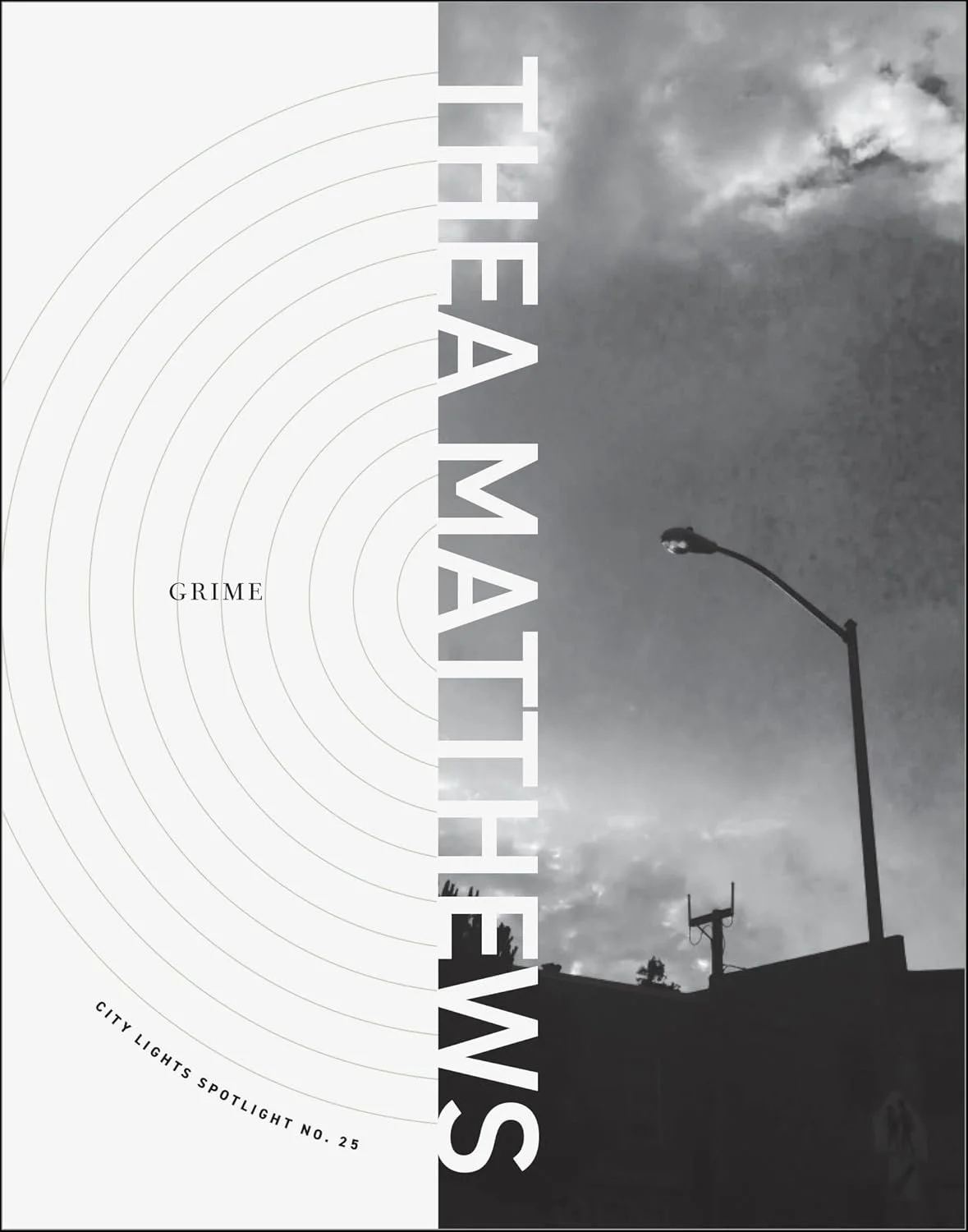
Barrelhouse Reviews: Grime by Thea Matthews
Reviewed by Rae Diamond
City Lights Books / September 2025 / 128 pp
Thea Matthews’s latest collection, GRIME, coils and gleams down into the conspicuously unlit corners of the American collective mind. When I first heard Matthews read from GRIME, I was a nature lover with a sensitive nervous system, recovering from the trauma of being unhoused, and living in one of the grittiest neighborhoods in the San Francisco Bay Area. Her words coursed through me like a lightning bolt, resonating at the same frequency as the freeway fume and stale urine stench of my grim cement environment, and I knew GRIME could teach me how to abide in that painful world of pollution, disrepair, addicts, unhoused schizophrenics, and other souls lost in the rigged maze of the capitalist American dream. Indeed, this meticulously crafted collection is a textbook about how to neither gawk at nor look away from the darkness of our culture, but to hold it in a steady gaze with presence, compassion, and inquiry.
Matthews’s poems bring the reader into the stretchy time of the mind, which enables the reader to look at what we as a society are doing with guns; to look at who is holding the guns; to look at who is on the other side of the guns. To look at how men treat women, how families treat each other. How our society treats the mentally unwell. How white people treat Black people. This propels the reader to understand who is ending up in gutters and caskets and cells.
The poems are intimate monologues, but because Matthews utilizes a protean lens, the reader doesn’t know whose mind they’ll be inside of next—the minds of victims, the minds of perpetrators, and the minds that exist in a space that blurs such distinctions. “In My Room: A Golden Shovel” extracts text from the work of William Carlos Williams, and takes the reader inside the traumatized-beyond-repair mind of Kalief Browder, a young Black man who was kept in solitary confinement for nearly two years after being wrongfully arrested: “I punch a wall to stare inside a canyon so / empty the edge cannot be erased. Life is too much / to bear with nightmares.” And with the stoic insistence of a Zen master, she unflinchingly draws the reader into the sullied state of Derek Chauvin’s consciousness as he snuffs out the life of George Floyd in “On East 38th Street.” “We got him” recurs like an insistent refrain that feels like a bell toll—a toll that rings in the reader’s veins until the poem closes: “and another man / says there is no pulse, and still, / I can’t move, / I’m chained to the rapture.” The bell goes silent. And the reader’s breath catches in their throat. And they pause. And then they go on to read an ekphrastic poem inspired by JoeSam.’s Surivor, 2015, an assemblage honoring the victims of white supremacist Dylann Roof, who shot and killed nine worshippers in a Black Methodist church. Matthews translates the artwork into lyric language and imagery that lift the reader into the agonizing suspension of the “survivor,” and then bring them gently down with the poem’s closing reminder to pause long enough to let this anguish sink in: “A black tomb- / stone sprouts as nine doves / fly over my head. / Selah.”
With the compassion of a universal mother, Matthews guides the reader into the addled minds of crack addicts and the resigned minds of prostitutes. In “Razor,” the reader stumbles with the narrator along the piercingly thin edge an addict walks between life and death: “Bones rip apart, / my ribcage dismantled / to sell for dope and each / valve of my heart— / ghosts blow bubbles.” Meanwhile, the narrator of “Inside County Lines” offers a tutorial on the hooker’s life, instructing the reader to “be a good mare, trained, / another night, another hand.” She closes her tutorial with “Obey! / No one’s coming / for us.”
Matthews extracts nightmare grime from beneath the pillows of the children of alcoholic, violent, and incestuous parents—and shows us how this grime is passed down. In “At Gramma’s House,” a barn owl watches over the generations as “the one who was beaten with a broom. / He becomes a man using extension cords / and leather belts to say as father / I see you. May my kisses be your welts.” With delicate and precise language, Matthews shows us how grime is not just dark, sticky, and putrid, but also—astonishingly—luminous, because it, like everything on this planet, is made of stardust. In “Abaddon,” a poem that teeters obtusely between devotion and torment, she tells us, “a sparrow’s wingspan is in midflight next to asphalt. / The lonely blue / seeps through a bloated chest of white feathers.”
Matthews’s deftness of language, cleanness of form, and laser-focused intent presents the reader with a collection of prayers in the guise of poems: prayers of devotion for the unloved; prayers of compassion for hearts turned inside out by overwhelming pain and injustice; prayers of mourning for untimely deaths, unjust deaths, soul deaths; prayers of healing for wounds inflicted, wounds received, wounds still gaping; prayers of witness for the unwitnessed, the swept-under-the-rug, the blindness of injustice; prayers as incantations for revolution. “Revolution Is the Hope of the Hopeless” concludes with “Revolution begins at rock bottom.” In an era when the scales of equity have tipped over altogether, GRIME offers the reader the ability to locate, inspect, and be present in the grit and ooze beneath the bedrock of this country. Because it’s there—in the grime—that our hearts can be cleansed of ignorance, and thus awaken to the understanding and compassion that might catalyze a safe, equitable, and vibrant world for all.
Rae Diamond is a neurodivergent interdisciplinary creator, educator, healer, and environmentalist. Their books include the hybrid collection, floating bones (First Matter Press), and the eco-fabulist Cantigee Oracle (North Atlantic Books). Their reviews appear in Tupelo Quarterly and Barrelhouse, and their poems may be found in Petrichor, Wild Roof, BlazeVOX, and others. Rae is a freelance editor, leads nature-inspired writing workshops, studies and teaches Qigong, and communes daily with the wild. They live among cedars, seals, and barred owls on Cayuse, Umatilla, and Walla Walla land (Olympia, WA). Find them online at raediamond.com and @raediamond on Substack.