
Reviewed by Brooke Stanish
New Directions / October 2025 / 144 pp
Living in the closet of a retired actress/active member of a thriving polycule for $650/month, Cumin Baleen–“Cum” for short–is trying to write the book the reader is currently reading. Prescription drug-addled and suffering from a rare autoimmune disease and “extreme bralessness,” Cumin’s attempts amount to nearly nothing before her life grows increasingly, irredeemably absurd. For readers of works like Franz Kafka’s The Castle or Clarice Lispector’s An Apprenticeship, Or the Book of Pleasures, Caren Beilin’s Sea, Poison poses the question: How does a writer, or anyone really, cope in a world filled with waiting rooms, part-time jobs at trendy health stores, and expertly coordinated medical malpractice? As Cumin herself notes: “it is so hard, in life, to get off of the nose. To climb out of your coffin. But people really need you to do that.” Sea, Poison is, among many things, a book about just this: climbing out of the nonsense.
Beilin’s narrative begins in the “waiting arena”of the Moody Eye Clinic in Philadelphia. According to Cumin, Philadelphia is a “city of universities and their hospitals, or perhaps the other way around,” and so, naturally, much of Sea, Poison revolves around Cumin trying to find a medication for her autoimmune disease. On the surface, this is an intensely boring preoccupation. That is the point. The waiting room of an eye clinic isn’t exactly the kind of place in which one might expect an experimental novel to begin. And yet, this is exactly what makes Beilin’s narrative so compelling, and so disturbing. In many respects, Sea, Poison is not absurdist at all.
In the rapid, matter-of-fact pace that characterizes much of Beilin’s prose, this seemingly routine eye appointment leads to a purposefully botched laser eye surgery–devised by Cumin’s arch-nemesis and character foil, Janine–in an attempt to make her a better writer. “Are you writing shorter sentences at all?” asks Cumin’s ex-boyfriend-turned-cult-member who is, inexplicably, involved in Janine’s plot too.
“I guess she was gonna take a shot at that veritable wasp’s nest of commas–clauses–in your head?”
“Mari. I need those.”
“Don’t you want to do more with your writing, with your life? Like not publish something yourself and hand it out to a few friends?”
But, all brain damage does for Cumin is clog her capacity for language entirely–to the point where the only things she can write are “soft polypropylene-like constructions like ‘I love you.’”
Somehow, nearly every character in Sea, Poison is a part of Janine’s plot to turn Cumin into a better writer by way of brain damage. The entire city of Philadelphia appears to revolve around whether Cumin will finally write shorter sentences. Even her former-actress-landlady, Maron–a woman who, according to Cumin, resembles Daniel Day Lewis and “a goth deer”–as well as one of the men she sleeps with, even despite Cumin’s presence in the closet, are aware of the scheme.
“We need your sample.”
“You should write us that sample. Are you writing anything at all lately?”
The reader is left to wonder whether an entire city really is in on a dubious plot to turn an otherwise little-known-writer into “the next Shusaku Endo!” or whether this is all in Cumin’s head.
Over the course of Cumin’s semi-Quixotic quest to write long sentences again, she discovers how it is that one of Maron’s lovers, Alix, gets patients to use a bedpan, an apparently notoriously difficult task for a patient to complete, one whose failure “predicts their backslide. And death.”
“All I had to do was go in there with the fucking bedpan, Cumin. With cordless headphones, I say hello to the patient, HELLO, HI, but distracted like taking a call from my girlfriend. I help the man get on the bedpan. I put him into the position. I say it’s fine, don’t worry, please don’t worry about that, you’re fucking paranoid, bitch, I’m working at work what the fuck, I’m doing my job, where the fuck do you think I am, and the bedpan is filling up. It’s delicious. Bitch, whore. It excites and opens a sphincter.”
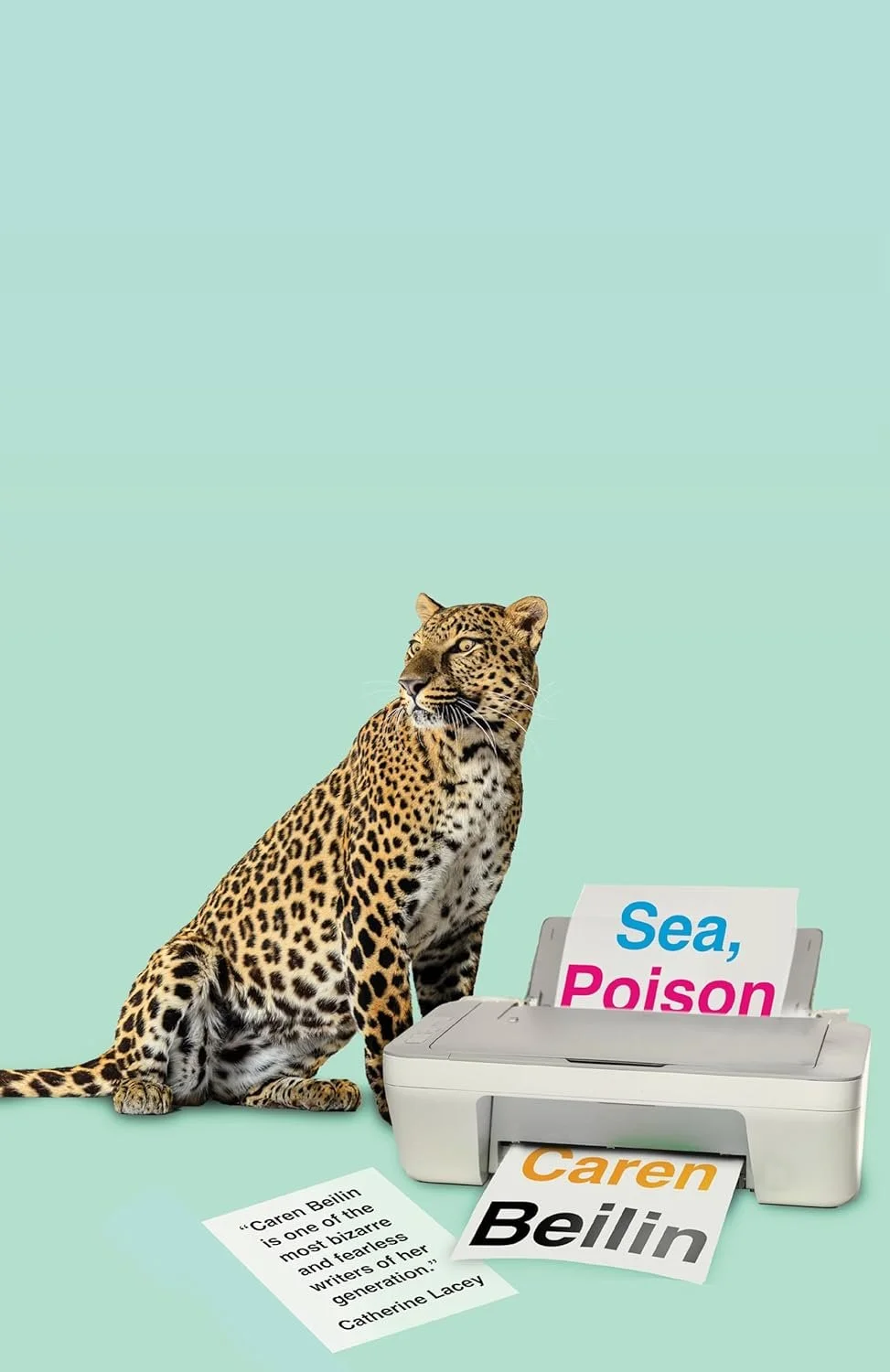
Cumin also learns of the origin of the life-sized stuffed leopard Maron keeps in her spare room, otherwise empty except for a printer. Alix informs Cumin that “she got attacked by a leopard. It opened up her back and took out a kidney, her spleen, and sliced open, too, her bowel.”From her experience being raped by her father and then attacked by the leopard her father trains to follow her around, she creates “a one-woman show. It’s a bit of a tiresome but also obviously sympathetic and affecting ninety-minute one-sided conversation with that stuffed leopard.”
In one of the final turns of the novel, Cumin is ironically trapped in an MFA thesis reading: “We were going to be treated to ‘a long short story.’ Oh my god…I shuddered. I said to my tablemate, ‘We should get out of here. Pronto.’” But, Cumin does not escape in time, and so, the narrative transforms into that of the young man’s MFA thesis–the coming-of-age story of a young, self-proclaimed punk who, in his adulthood, becomes complicit in a scheme to steal uteri.
And this is where the last portion of the novel lands: on the illicit schemes of powerful, deceitful doctors, one of the novel’s overarching preoccupations. The otherwise darkly comedic tone of the novel shifts in the latter portion of the piece to that of a more serious strain, confronting the absurd though indisputable reality of medical malpractice. And so, the novel closes on the chapter entitled “Why Would There Be A Uterus” in which the reader discovers if Cumin will finally regain her stolen capacity for complex language, as one might regain a stolen uterus.
As I do while reading many of my favorite books–especially those with an absurdist bent–I read much of Sea, Poison wondering: “What is happening?” Cumin answers this question for me: “A novel is like that, about something happening,” and much happens in Sea, Poison. But, more than anything, what stays with me most vividly after finishing the novel is Beilin’s voice. I cannot describe its sound precisely. Her voice is uncanny, desperate, deviant, and cold. Her voice is the world she creates.
Brooke Stanish is a writer and MFA candidate at Louisiana State University. Her work appears or is forthcoming in Bloodletter, Sans.PRESS, After Dinner Conversation, Josephine Quarterly, Either/Or, and elsewhere. She is also the recipient of the David Madden Award for Fiction.