
Barrelhouse Reviews: Making a Kingdom of It by Lance Larsen
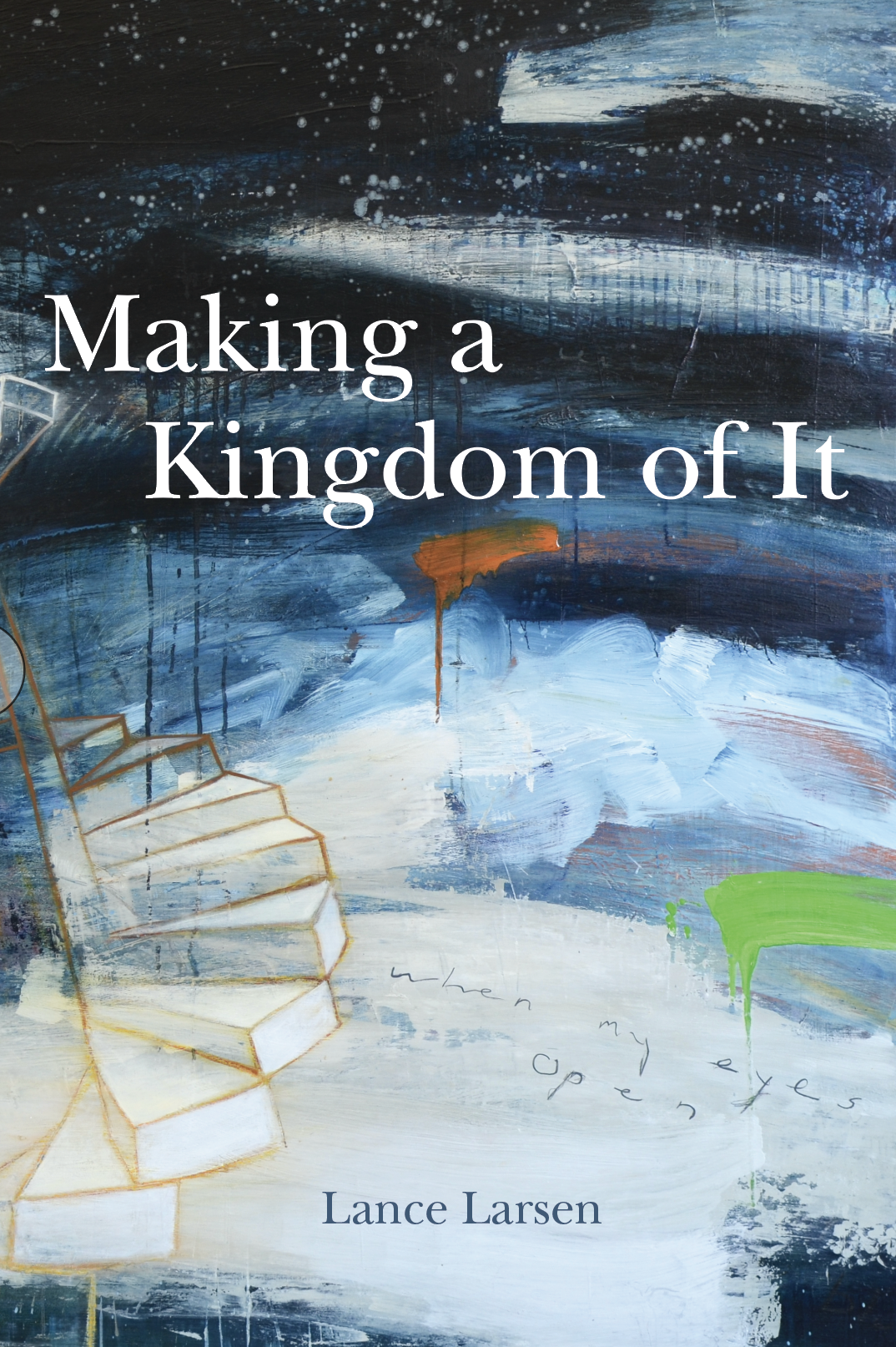
Reviewed by Tamara Pace Thomson
University of Tampa Press / December 2024 / 86 pp
Lance Larsen’s sixth collection of poetry, Making a Kingdom of It, is populated by angels, widows, dementia patients, self-harming teens, garter snakes, and murdered robins. He eulogizes friends, family members, and past professors. And while his previous collections include elegies, these poems, even when they are about other people, often feel like meditations on his own future death. He acknowledges, perhaps, that being in his sixties means being in the last quarter of his life (at the very least), but his death poems are also composed against death, as Harold Bloom would say. His keen observations and insights offer a newfound intensity, and his playful and witty moments give over more often than in earlier collections to an urgency to witness and record.
For instance, in “Why I Kissed the Dead Man” he kisses his dead father-in-law not because he loves him but “because I wanted and still want someone/ to kiss me after I die, someone with three/ days’ growth of beard who doesn’t have to.” In imagining his own loss, he disrupts potential fear and rejects the maudlin. He also cushions each loss, whether of memory or life, with sensory potency, like the blind woman in “Whatever Scared Hand” who lets her Labrador retriever lick her fingers, then lifts “her hand close to her face/ and sniffed. Who knew that the smell/ of dog saliva could bring comfort?”
The collection begins in childhood. Larsen describes a shared miracle between young son and mother while they drive home from the ER. She distracts her son from painful stitches by drawing various objects on his back with her finger. He guesses at the objects while experiencing the exhilaration of creating from suggestion—not unlike the exhilaration one feels when reading or writing poetry: “Even wrong guesses were a revelation in texture/ and touch, not a comb but a rake, not a swing set/ but an octopus.” And then this transcendent moment of figuration:
Then the marvelous erasing:
just the broad warm flat of her hand. Like someone
swabbing a deck. Or polishing it maybe. I was pure
palimpsest, ions and vectors, a swirling energy
I hadn’t yet grown into.
So begins Larsen’s lyrical inquiry and examination of the private miracle, the private sacrament, and the private devotion that comes from an erasure of the self, “How she turned/ me into nothing.” The contradiction of being nothing while also being a palimpsest reminds us that language and metaphor reveal the individual self even as they absorb that self (particularly the poetic self) into the universal.
Larsen’s universal in this collection is often loss and disease, especially the diseases of the mind in old age. In “Blessing the Sacrament in My In-laws’ Garage” he describes the minutiae of what vanishes with dementia: “goodbye/ Thailand, so long Peru, also farewell to continental/ drift and Bay of Pigs and the faces of three/ adult grandchildren who visited at New Year’s.” Meanwhile, in “Understudy,” we see the speaker explaining to his mother-in-law her own photos in hopes of helping her retain the associated memories. She asks if the grandchildren in the pictures all came out of her: “Each day dementia maroons her/ on a new island. No, I say, out of your daughter.” Larsen knows the loss of memory is really a loss of self, and he memorializes the self and even its erasure on every page.
One of Larsen’s charms is the way he connects incongruent images so they may coalesce into meaning: “Trout jump to kiss her, then fall back like spent rockets” (“After a Perplexing Day the Moon”), and “I warm my hands in this funk solstice/ and dross offal and equinox” ( “Compost”), and “The moon is her luffa, with the Big Dipper/ she spoons steaming water over her nakedness” (“After Reading Song of Songs, I Take Out the Garbage”). He confers form through disparate objects and descriptions, and he makes apparent that which is caught between the emotional and the corporeal.
And then there is the way he ends many of his poems. Donald Hall advises poets to avoid authorial intrusion when ending a poem by using “image bursts” and by letting “the words flash a conclusion then get out of the way.” Larsen does exactly that with ending images like “her fierce high plains/ face tilted in first light, eyes wet,/ her big elk mouth powdered with pollen” (“I Caught an Elk Chewing”), and “On the couch tonight she’ll light his last cigarette/ and let it smolder down to ash while she eats/ a pomegranate, jewel by bleeding jewel” (“Widow Water”), and “Flag doing nothing patriotic with its rippling stripes” (“To the Girl in Fourth Grade Who Stapled Her Arm”). Such endings invigorate the figurative leaps without reductive overexplaining. They allow the reader to delight in unexpected and gratifying images.
In “Pantheism for Beginners,” Larsen describes the joy of watching his shadow predictably follow his movements, “How I love obedience.” And although it may be taking his line a bit out of context, one sometimes wants to tell Larsen to stop being so obedient, so orderly, so tightly constrained. There is meaning in order, but sometimes we need a bit of chaos through which to hunt for it. Not that he is overly prescriptive in how a reader should interpret his poems, but sometimes there is a tidiness to his language that feels just a bit precious, as in the poem “An Amateur’s Guide to Holiness”: “a single muskrat paddling the Arno/ like a prayerful pope.” However, such moments are rare and easily eclipsed in the splendor of lines and enjambments like these, from the same poem: “the drip drip of grotto/ water in Boboli Gardens, the taste of blood/ orange gelato at night on your wooing mouth.”
Larsen’s poems deal with miracles, the spiritual, and the religious. Many of his poems do not just acknowledge the metaphysical but are themselves psalms and prayers: “Till then we bow our heads to this glorious/ broken now and we ask and we ask and we ask” (“Blessing the Sacrament in My In-laws’ Garage”). He is devoted to ritual and reverence: “For weeks, I’ve been saying (are you even/ here?), weeks letting wind say my prayers,” (“After Reading Ecclesiastes, I Walk the Foothills in Search of Owls”). He invites his readers to abandon the skeptical, rational aspirations of our age to once again “entertain the mysteries” and to trust imagination, while grounding that mystery in the physical, concrete world. Larsen knows that poetry can’t resolve our dark political reality through policy or resistance, and it certainly cannot stem the tide of 21st century injustice. But it can invite readers to make a kingdom of this transient world, to examine it with wonder and awe, and to turn perpetually toward the magic healing well of language.
Tamara Pace Thomson (she/her) is a lecturer in the English Department at Utah Valley University, where she teaches composition and creative writing. She writes mostly fiction and poetry but occasionally publishes essays and book reviews. She was recently a finalist for the 2024 AML Award for Short Fiction. She and her husband have three children and three children-in-law. Tamara likes to spend her extra time with her family and their various pets.