
Tiptoe-ing Around Before Running Full-Tilt: An Interview with Mahreen Sohail, winner of the PEN/Faulkner Award for Fiction, by Kasey Peters
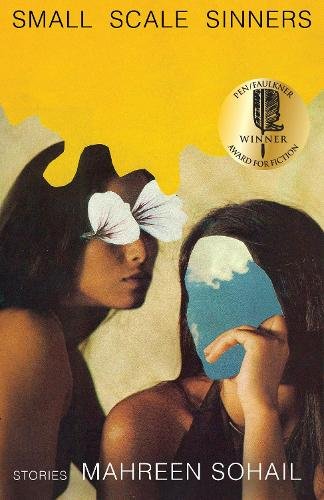
It took me about twenty-eight pages of Mahreen Sohail’s collection Small Scale Sinners to decide I was changing my fiction syllabus to center this book. Okay, it took me exactly twenty-eight pages. On page twenty-eight, a few scenes into the story “Hair,” there is a strange, see-sawing moment of transformation between two characters in which one’s transcendence is another’s deflation. When I read that moment, I was both characters. I might describe this whole book that way: a see-sawing, a simultaneity, a weird internal disorientation that is also self-recognition. I may have to write about Sohail’s work in the abstract forever because I’ll forever be groping to articulate just how good it is. Luckily for me, Small Scale Sinners just won the PEN/Faulkner Award for Fiction, so you can take somebody else’s word for it.
I had the great honor to correspond with Sohail via email in the early months of 2026 about her voice, the speculative leap, and the preposterously expansive and all-encompassing aboutness of telling the same story again and again.
Kasey Peters - I'm very excited to be in conversation with you about Small Scale Sinners! The collection is remarkable, and I wanted to start out with a question about the voice you employ in this book. It seems to me stunningly unique.
While there is often situational urgency in the stories, the voice speaks to the reader with something like distance or detachment, or at least a very controlled affect. In many of the stories, this simultaneity is haunting, and it facilitates these moments of profound rupture. The urgency of the story breaks through that controlled affect in transcendent moments. Sometimes the moment is a fourth-wall break, or a metafictional aside, or an expression of such intense emotion that the character suddenly seems to go from black-and-white to blindingly colorful. I would describe the reading experience as realizing that the sensation of ringing in your ears is actually tornado sirens going off: that nagging anxiety blows up into the real world.
My question, maybe strangely I guess, is: How did this become the voice in which you write? How did you come to this voice, or how did it come to you?
Mahreen Sohail - I love this question! To be honest, I'm not sure about how I arrived at this voice, but once I did, I couldn't seem to shake it off. I worried often that I was writing the same story over and over again and tried to experiment with form, structure, POV -- to show myself that the stories could stand on other legs too. But that aside, over the past couple of years (and especially in the past couple of days re: world events), I feel like I've been walking around with this sense of foreboding, like something is about to give. Sometimes this sense is not foreboding but rather hope and then it gives way to joy, but of late it's been more of a sad, I am a sinking feeling. I'm kind of aware (as I'm sure a lot of people are), that everything is ending -- I feel sucked into my phone, the meaninglessness of the work day, just hours of admin work, making meals, the mundaneness of everyday life -- and grateful when something breaks through the monotony, terrified when the thing that breaks through is horrible. This is a long way of saying that maybe this voice is the way I see the world, or the way I saw the world when I was writing the stories, and maybe the characters took on this way of tip-toeing around before running from/towards something full-tilt.
KP - Wow, yes, that feels exactly right. And it's interesting to hear you say you felt you were writing the same story again and again. Sure, the collection has these motifs: there are several mother-daughter relationships, several iterations of marriage, several ways to think about girlhood and womanhood. On the one hand, there's domesticity and gender regulation at the heart of the book. But also, a bunch of kids murder a teacher, there's a domestic violence vigilante situation, and two protagonists participate in a horrific, surrealist, child soldier operation! It seems like if the stories are about any 'same thing,' they are about the ways we watch patriarchal, colonialist, capitalist oppression end the world again and again, even in the smallest, most intimate parts of our lives. And those ways seem sort of infinitely diverse and simultaneously, harrowingly, the same. So it both makes sense to me and seems magical that your work plays so weirdly in this space. How did you start experimenting with form and POV and the nearly-speculative elements of your work? Was that kind of work fun? Easy? Scary?
MS - Yes, I think fun is a good word. Playing with form allowed for some breathing room while writing. Mostly, I didn't have to worry about being present in time. I could jump forward years or stay in one place, and then jump through a decade. I didn't have to move characters from the chair to bed to the kitchen and that was also liberating. I think the more traditional or formally written stories were me trying to prove to myself that I could actually write stories that were traditional (a character moving through a beginning, middle and an end -- this happened and then this happened), and the writing of them could shift something in me, but the more experimental stories like Sisters, or A List of Places My Mother Was Old came charged with this sense of possibility -- this story can do anything! -- that I really enjoyed. The speculative elements were really just a manifestation of my brain going "What if," and following that thought through. We don't get to do that often in real life, so it was fun (again, that word!) to do it in fiction. And often, I think, the strange paths our mind leads us down are worth following --- they lead to unexpected places and reveal truths about ourselves that we may not otherwise have known.
KP - Well, you’ve convinced me to take the speculative leap myself. And formal leaps, too. (Of course, the imagery of your story The Man Who Flew comes to mind, which I won’t spoil for readers; suffice it to say: take the leap!) The experimental stories you mentioned, Sisters and A List of Places My Mother Was Old feel nearly like they resist genre, or came out of working with poetry, or something like that. They facilitate this sensation of puncture, of urgency, of emotional vulnerability. My experience of reading them was sort of like reading somebody’s diary—not that they resemble journaling whatsoever, but because it felt like privileged material, like maybe I was peeking. And I think that idea of privacy and the personal and all that vulnerability and trust comes up a few times in the collection, so I wanted to ask about your sense of mediating that in your fiction. How close do you let it get to you, and vice versa? How do you distance yourself from it? I once had a workshop leader ask me if my story was ‘really bleeding,’ by which she meant, ‘did you hurt yourself to write this?’—the implication being, if you don’t, it’s not a very good story. What do you make of that relationship to the story?
MS - I think something can be completely made up and still ring true because it comes from this strange place inside the writer and greets this strange place inside the reader and the two share a moment of recognition. This moment is probably why I read, this sense of, oh you’ve felt it too. I don’t have a sister, but the story Sisters in my collection is partly a product of observing sisters together and longing for one for years and years. A List of Places My Mother is Old has a few more elements from my life, but they are exaggerated, changed, almost unrecognizable from the facts of my life in their final form in the story but both stories are emotionally true and maybe that’s why those are the two pieces that are so pared down language-wise. I kind of had to keep reaching for emotion in those pieces and it didn’t come from scenes or plot, more the relationship between the mother and the daughter in one piece, and the sisters in another.
I’m not sure about hurting myself to write. I hesitate to ask people or writers to engage in self-flagellation to make art on the page when life is so hard already, but I do think writing should feel like it takes something from you — like you’re doing something meaningful and that it matters.
KP - Gosh, so beautifully put. You just articulated this sense of connection I’m always striving for as a reader and writer, this oh, you’ve felt it too recognition. I think all the stories in this collection manage to do that simultaneous perfect thing of alienation and self-identification: I feel like I’m totally in another world, and yet, the narratives are somehow about me, too. And it’s hard work! So of course I’m curious if you’re working on a novel and how you think about the longer form.
MS - I am working on a novel, yes. I think the longer form is mysterious to me; it’s hard for me to keep a long project in my head with all its various intricacies. I think it’s easier to see the end with short stories. I think so much of novel writing is just pure faith — believing that you’ll get to the end if you just keep going.
Mahreen Sohail’s collection Small Scale Sinners won the 2026 PEN/Faulkner Award in Fiction. Sohail was born in Islamabad, Pakistan. She has an MFA from Sarah Lawrence College, where she studied as a Fulbright Scholar, and was a Writing Fellow at A Public Space and a Charles Pick Fellow at the University of East Anglia. Her work has appeared in Granta, The Kenyon Review, Pushcart Prize XLII, and elsewhere. She lives in Washington, DC.