
Barrelhouse Reviews: Self-Portrait as the ‘i’ in Florida by P. Scott Cunningham
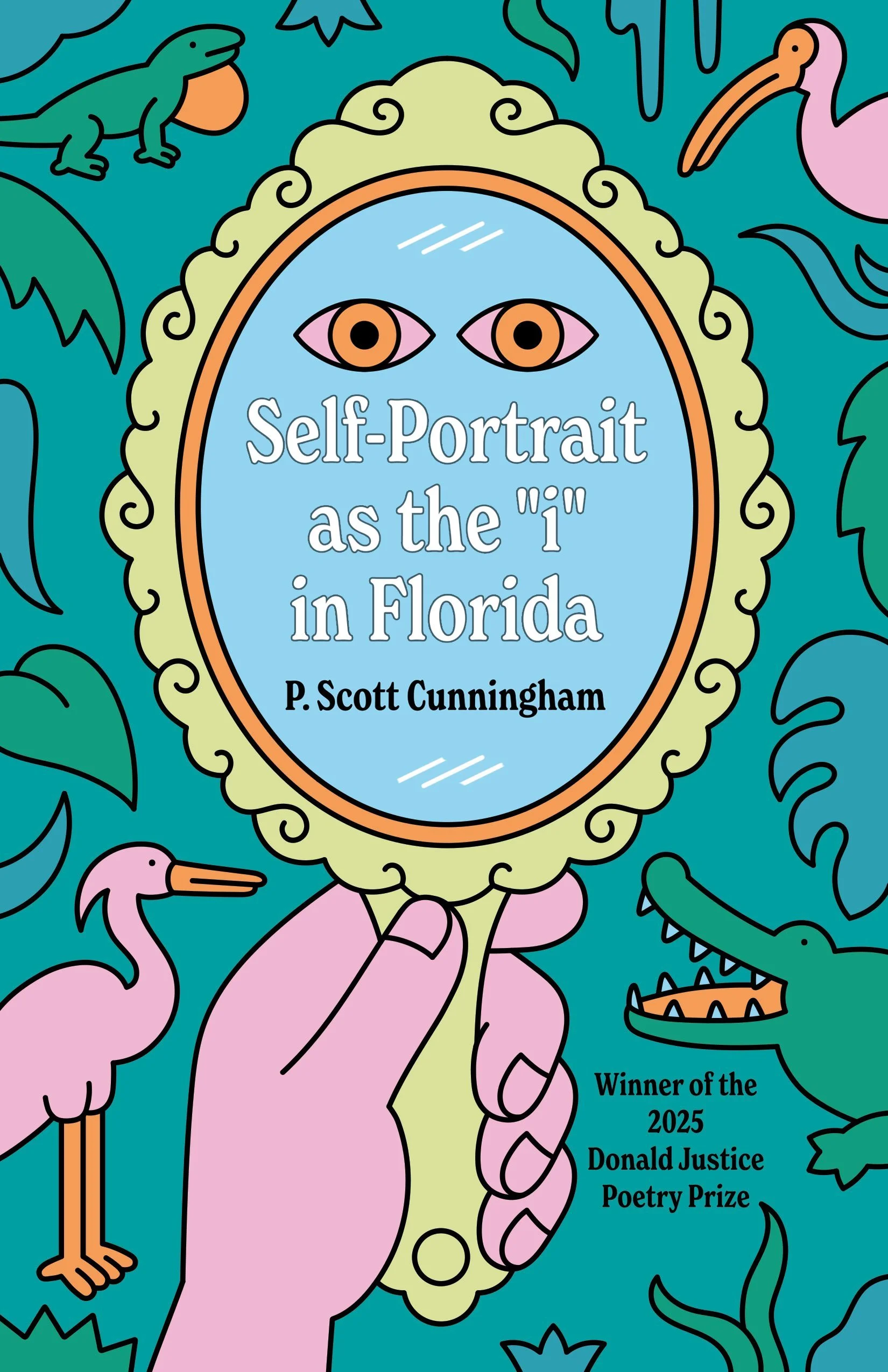
Reviewed by Nate Miller
Autumn House Press / April 2026 / 94 pp
The state of Florida occupies a contradictory cultural space—it is at once an idea and a physical place, a right-wing politic and a swamp. Everything it contains is distorted, somehow: the real world reflected in a dirty mirror. P. Scott Cunningham’s latest poetry collection accepts that conception while lovingly elaborating on the beauty inherent in it.
Cunningham initially concerns himself with the physical state—its wilderness, its overgrowth—and renders beautiful its rough edges. His Florida is a wasteland, yes, but it is a wasteland that prefers to be wasted, and the beauty of which lies in its waste. In “Florida Snow,” he likens ash to “pieces of the moon” falling from the sky, while in “The Mango Tree Hanging Over the I-95 Retaining Wall,” he depicts a mango tree dropping its fruit:
without warning
on the edge of the asphalt
where they break and bleed out their juice
into a permanent shadow.
Cunningham meditates on Florida’s ruin. Speaking to the titular yacht in “A Capsized Yacht on Biscayne Bay” he writes:
capsized being the position you prefer
you want half the world to be a sky
and half the silt in the end
you’re incapable of pretending that you can survive
for even one day outside of the place
you call home.
Cunningham’s Florida is literal to the extreme: he goes so far as to include the addresses of many of his poems’ (non-human) subjects before the poems themselves. He fixes his gaze on Miami’s bridges and coin laundromats, its rotting docks, its neglected emblems of mundanity. It’s near-saccharine how much he loves the place, how he, in “Shucker's Bar & Grill,” transforms into relics such cheap commercial items as:
a bucket of Coronas upended in ice,
a plate of bones that used to be wings
a plate of something golden and shimmering,
like the brain of an animal emptied of
memories
It’s equally unbelievable how successful he is in these moments, how perfectly he calibrates his odes to contain as much heartfelt praise as possible without exuding too much, and how overpowering his sincerity is. “If you love the world for the way that it is, there’s nowhere better than Miami,” he writes in "Ode to Taco Bell," and you can’t help but see this place he loves as he does.
At points, and especially in the collection’s later pages, Cunningham’s adoration for the state, along with his self-awareness and occasional cleverness, perhaps tip the poetry toward heavy-handedness. Take, for instance, “Poem Beginning with an Infamous Florida Billboard,” which begins:
your wife is hot
time to fix your air-conditioning
maybe it’s also time
to tell your wife she’s hot
to stare at her with the same intensity
that you stare at
roadside advertisements
It’s a proclamation that, while it may be well-meaning, is inevitably banal in its attempt at transcendence.
Cunningham also occasionally attempts rhyme schemes (which, to his credit, he acknowledges in another meta-poem many consider “precious or dated or just plain annoying”), which more often falter than they succeed. In doing so, he distracts from his consistently beautiful Floridian imagery. For instance, in “Landing, Miami International Airport,” his take on a sonnet constructed out of couplets, he writes:
I step off the plane and smell the humidity—
the canal, the marl, the concrete’s ubiquity.
A day without clouds? That’s just some publicity.
Water is everywhere. It’s called a utility.
I found myself in these moments frustrated with Cunningham, who trades in his skill at subversive evocation for stilted, self-impressed lines.
Toward the end of his collection, he turns his gaze inward—to himself, to the people he holds close—and in doing so cultivates quiet moments as unsubtle as they are profound. For Cunningham thrives on the obvious, and on converting it inextricably into revelations both familiar and unfamiliar. “Poem in Which I Write Us into Episodes of The Sopranos,” for instance, transposes mundane moments from his and his wife’s own lives onto various plots of the television show—the effect of which could have been easy to imagine—but Cunningham’s poetry is funny, and charming, and so heartfelt that we fall into his magic trap.
The collection is an overall success from a writer who’s unafraid to have fun by embracing the contradictions of a place he loves. To read it is to experience not only the beauty of the overgrown Floridian countryside but some lovely human truths—and to do so through the eyes of Cunningham is nothing if not a pleasure.
Nate Miller is a writer and musician living in Michigan.