
Living, Together: Barrelhousing with Samantha Paige Rosen, Interview by Hannah Grieco
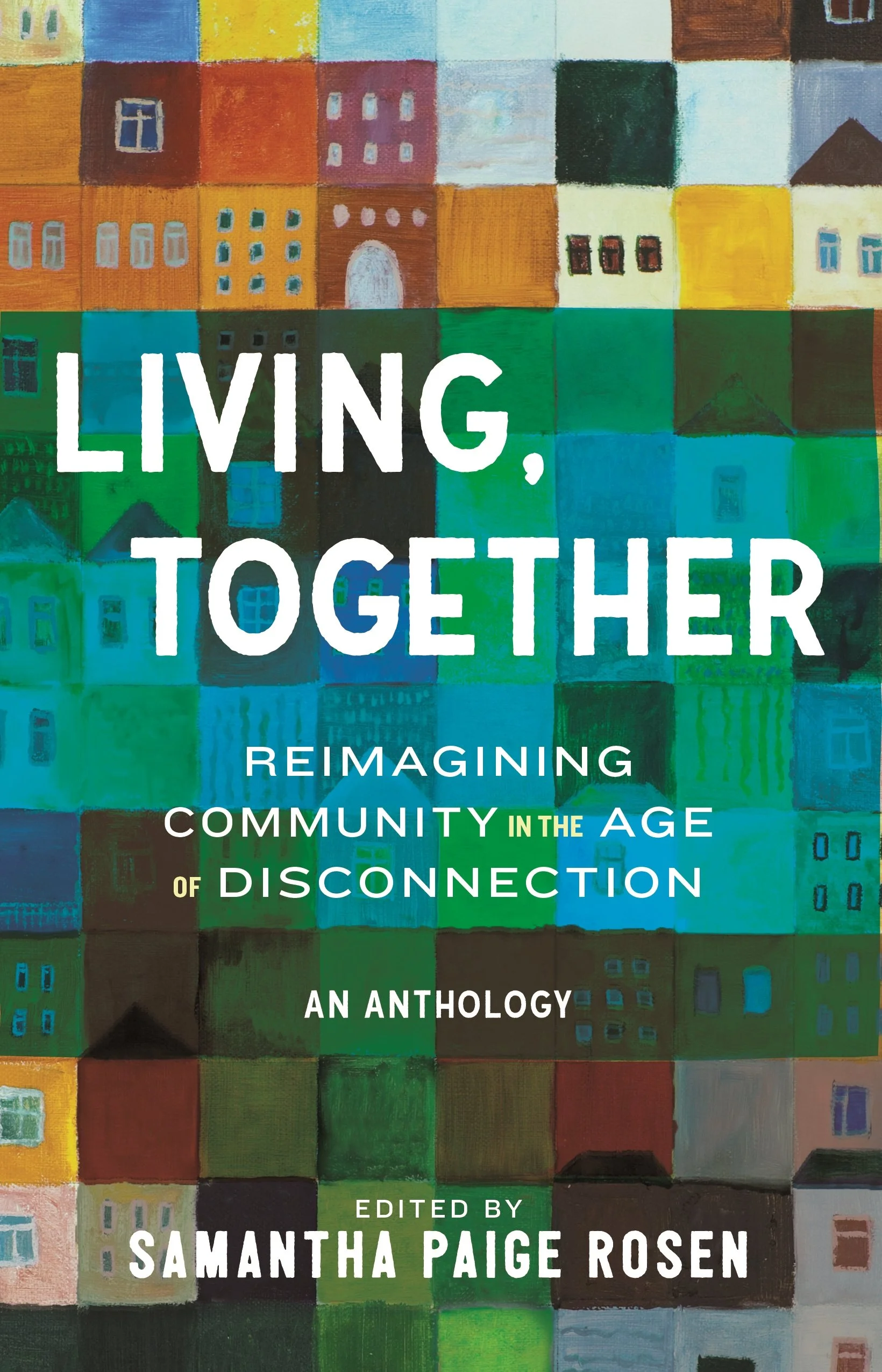
The current timeline in the US is isolationist to the extreme, but Samantha Paige Rosen emailed me a while back to discuss that very thing: isolation. She'd been writing about different types of communities, the various ways we build and experience family, and she was interested in editing an anthology about it. Two years later, Living Together, Reimagining Community in the Age of Disconnection is here! And I got to write an essay for it, too! This book has been a deeply moving project to contribute to, and I was excited to dig into Samantha's brain to learn more about her process as an editor.
Barrelhouse: Tell us about Living, Together: Reimagining Community in the Age of Disconnection!
Samantha Paige Rosen: Living, Together is an anthology about communal living and community building that was inspired by my experience unexpectedly moving back in with my parents in my late 20s. I was surprised that I loved living with my parents so much—I stayed for six years! As I say in my introduction to the book, I’d been living alone, working a series of punishing jobs, and the connection and care I felt when I became roommates with my parents changed everything. Why had no one told me this was an option for how to live? What were other ways of living I was missing out on simply because American culture doesn’t promote them? The anthology was born out of wanting to find out, for myself as much as for readers, and the central question of the book became: How might we live together in order to have happier, healthier, and more connected lives?
In 15 essays and six Q&As organized into three sections—Family Homes, Intentional Communities, and Beyond Housing—contributors, including Sarah Thankam Mathews, Jonathan Escoffery, Kim Stanley Robinson, Kristen Arnett, Rhaina Cohen, Simone Gorrindo, and you, Hannah Grieco (!), share the different ways they’ve built mutual care and belonging, both within and outside of home. These are people who live in every region of the country and range in age from their mid-20s to early 90s, so I hope readers with all types of identities and life experiences can find points of connection in the book.
There are also many relevant topics that weave through these essays and different living scenarios, including loneliness, aging, friendship, chosen family, illness, parenting, intergenerational relationships, artist community, colonization, immigrant community, relationships between neighbors, the challenges of being in the sandwich generation, polyamorous living and parenting, queerness and queer community, financial hardship, the natural world, sibling relationships, and, of course, housing.
BH: What was missing, on the page and off, in the current conversation about loneliness and housing?
SPR: Nuclear family living has been in decline for the last nearly sixty years, yet only with the loneliness of the pandemic and the recent housing crisis have stories about people turning to other ways of organizing their homes and care networks started to be covered more by the media. Even now though, and despite the fact that communal living is more relevant than it has ever been, we’re often not hearing directly from those who have experienced it, beyond a soundbite or two. But these are the people who can really show us what it’s like—who can capture the way more regular and localized interdependence can address societal problems, including loneliness, and share the tradeoffs, too. That’s the gap my book aims to fill.
Similarly, I didn’t have many people in my life who I could look to for alternative ways of living until I started working on Living, Together. Most everyone I know either lives with nuclear family or alone, or with roommates if they’re in their young 20s. When you’re already isolated and under-supported, especially in your home life like so many people in the U.S. are now, not being able to have conversations or models around ways of alleviating that can feel crushing. When people do have access to those conversations, whether through real life models or reading that you can then bring into discussion, it can feel like a door has been opened.
BH: And conversely, what does disconnection look like today, and how is it different from the past?
SPR: I think disconnection today looks like isolation and polarization. We were never as isolated in the past as we are now. Even at the height of nuclear family living, which occurred in the 1950s and 1960s, neighboring households relied on each other more in ways that were both practical and social. There were no phones to fall into for hours at a time—no algorithms, fragmented news sources, or internet echo chambers—instead of getting out, and connecting with and learning from others.
BH: You’re a wonderful essayist, yourself. What led you to wanting to edit an anthology vs writing a collection of your own essays?
SPR: That’s very kind of you to say. The chorus form always felt right for this particular project. If my goal was to show readers more of what’s possible in housing and community, I needed to offer a depth and breadth that they hadn’t previously seen. To do that, I needed the people who’ve lived those realities to tell their own stories, unpacking how they got into their housing situations, the pros and cons, the themes and takeaways, illustrating what days look like. I don’t think I could have conveyed all of that by reporting it. That’s also just not the kind of first book experience I wanted to have—running around reporting, writing all alone for years and years. I’m unfortunately an anxious-perfectionist type, and I have ADHD, too. I’m a little intimidated by the thought of writing a solo book-length project, and doing it well enough—although I will (next book). The anthology felt fun and energizing, rather than overwhelming, so for all these reasons, I knew it was the right choice.
BH: In my own essay, I speak to both the joys and tensions of living with my parents. What are some of the different ways this book explores the complicated nature of community?
SPR: I really tried to ensure that we weren’t looking at things with rose-colored glasses, so most of the pieces acknowledge the challenges of community alongside the joys. Your essay and Dani McClain’s essay, which are both about living with your parents and your children, speak to the difficulties of caregiving. While in your essay, you acknowledge that having your parents around does sometimes allow you to get some rest or have a chance to write when your parents occupy the kids for a bit, Dani—who moved in with her mother after her mother had a stroke—is pretty blunt about barely having a second for herself. But she also writes that it takes her very little to help her mom with things that are so difficult for her in comparison, and she’s glad to be able to do it.
Jonathan Escoffery, Sarah Thankam Mathews, and Kate Madden Yee’s pieces all get into the labor that’s required of being steeped in different forms of community, and how difficult and tiring that can be. Sarah Thankam Mathews’s essay reflects on the difficulties of creating and maintaining the mutual aid organization she founded six years ago, Bed Stuy Strong. Kate Madden Yee’s essay goes through the pros and cons of living in co-housing as she explores whether she wants to stay in the co-housing community she co-founded 20 years ago. And Alex Alberto writes about creating a form of family and home that they’d never seen before, through trial and error, which led to the home they live in now—a three-parent polyamorous household with two kids.
BH: Were there any surprising themes or contradictions that emerged across the essays?
SPR: I mentioned some of the shared contradictions above, but the most surprising theme that runs across many of these pieces is that communal living doesn’t necessitate a long-term commitment. Maybe some people who enter into communal living approach it as a lifestyle they’ll maintain forever, but working on this book showed me that this is not the case for most of us. We’ve entered into communal living when we’ve wanted it or needed it, some have left and then returned to it in different iterations or not, and all of that’s fine!
I hear people talk about wanting to live communally but they’re hesitant because they assume changes can’t be made if they don’t like where they live or who they live with. But communal living by nature is more flexible than nuclear family living, and the lack of flexible thinking around it seems to be a deterrent for people to enter into even though they might benefit from it.
BH: Do you see communal living as a personal lifestyle choice, or a necessary response to larger systemic issues?
SPR: More so the latter, but that doesn’t mean the former can’t also be true.
BH: How did you decide on the structure or organization of the book?
SPR: I thought about what I might want to see, especially if I was a reader coming to this anthology with an interest in learning more about a specific type of communal living or community building. It just felt natural to me to organize the book into people living in versions of nuclear family homes (including multigenerational homes, siblings living together in adulthood, and polyamorous households), then forms of communal living outside the nuclear family (originally I separated this into friends living together and intentional communities, but my agent didn’t think it was necessary and I didn’t feel strongly about it), and finally creating community beyond housing.
BH: Did any contributor’s perspective challenge your own assumptions about community?
SPR: Oh definitely. I’ll mention Rhaina Cohen, whose essay is about deciding with her husband that they wanted to live with friends, and their first and second iterations of doing that. It’s been my experience that most couples, especially married couples, don’t seem to want to live with friends, and I find Rhaina’s perspective to be really refreshing.
Also, I wanted to feature the perspective of a nomad, who lives and travels in their vehicle either by choice or circumstance, and meets up with other nomads. I imagined the lifestyle might be somewhat lonely, but Suanne Carlson, co-founder of the Homes on Wheels Alliance, who I did a Q&A with, told me she feels so much more at connected and at home in nature and with the community of nomads she meets up with a few times a year than she ever did in traditional housing. Maybe, for some people at least, it’s not as important to be with people frequently as it is to feel truly understood by people when you are with them.
BH: How did conversations with contributors shape the final vision of the anthology?
SPR: I worked with contributors on their pieces until everyone was happy—there was no set number of revisions. I think just the fact that we collaborated and negotiated toward landing what we mutually felt was the best version of each person’s piece resulted in this anthology saying exactly what we wanted it to say as a whole. And we got there because we were able to expand on each other’s ideas to determine the right structure, anecdotes, language, and takeaways for each essay.
More specifically, I can say there were certain writers and pieces that offered a real education in emotional resonance—you and Dani, for example—that I tried to learn from and apply to other essays so that the collection as a whole was as deeply felt as possible.
BH: What does your ideal version of “community” look like now, both personally and on a larger scale?
SPR: If we’re talking about “community” and not specifically communal living, my personal and larger scale answers are the same. I think we’d all feel less isolated if we could become more interdependent with our neighbors. If you want to deliberately move next to friends or family and make those people your neighbors and you have the means to do that, that’s great. But even if it’s just the people who live in your hallway or on your street, to me it seems important to find a few you like and want to be intentionally interdependent with. That could mean having dinner once a week or watching a weekly tv show together, asking if they need something when you’re at the grocery store, driving them to a doctors’ appointment or watching their kids for an hour—and vice versa for all of this.
I’ve personally experienced how feeling connected to people who live near me makes a difference in my mental health, sense of physical safety, and day-to-day practicalities. I’m not saying we have to love all our neighbors, but even an interdependent relationship with one household could make someone feel less alone in your corner of the world.
BH: Would you like to edit another anthology?
SPR: I would! I wrote an essay for LitHub about how much I loved the experience of working with my contributors. I’m a very collaborative person—there’s nothing better to me than when someone’s contribution makes your work better and vice versa—and this was the perfect first book experience. For the moment, I’ll be happy to get a break from coordinating the many moving pieces that are required to edit an anthology, but yes, would absolutely do it again.
BH: And, as always, we at Barrelhouse always want to know: What’s your favorite Patrick Swayze movie?
SPR: I take this question so seriously. I want to say Roadhouse because it’s cool or Ghost because of pottery but my true answer is Dirty Dancing. It’s where I first fell in love with him and where we get to see how talented he is as a dancer. Plus, “I carried a watermelon” is one of the best movie lines ever written.
Samantha Paige Rosen’s writing on identity, culture, and the arts has appeared in the Washington Post, Harper’s Bazaar, ELLE, Slate, Them, Literary Hub, and elsewhere. She earned her MFA from Sarah Lawrence College and lives outside of Philadelphia, where she is a freelance writer and editor, a writing tutor and coach, and an amateur potter. Living, Together: Reimagining Community in the Age of Disconnection is her first book.