Pleasure in the Telling: Barrelhousing with Eric Wat, by Kasey Peters
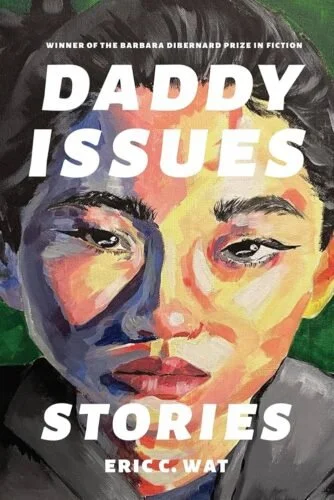
I knew I was going to love Eric C. Wat when I read his website bio and he described writing “for queer folks whose main concern in life isn’t coming out”—which is a nice way of describing what I would call queer people who are not flattened to that one singular drama in the weird vacuum of (white) (middle class) (pop-fic) queer lit. That is, Wat writes for and about people with immigrant families, difficult or precarious jobs, illnesses and/or addictions, and all the stuff of real life. And that’s exactly who populates his new collection, Daddy Issues, which is rendered in subtly punchy prose. The characters feel profoundly true to life. The best way I can describe the reading experience is that several times, at the close of a story, I held the book to my chest: I just wanted to hold these people, and be with them.
The stories are also wry and occasionally, devastatingly funny, and even a little bit spicy. Honestly, I also knew I was going to love Wat when I found this on his website: “I write about sex a lot, too, [...] Social justice should not be devoid of pleasure. In fact, pleasure should be a basis for activism!” Under that banner, I would follow Wat into battle. I was so thrilled to be in conversation with him.
Kasey Peters: One way to describe this collection is that it centers queer Asian characters in and around Los Angeles, but another facet that really struck me—and, of course, this is inextricable from those other descriptors—is that these stories are about family dynamics. Why is the family so important to your world-building?
Eric C. Wat: I agree with you — those family dynamics are inextricable from the queer Asianness of it all. For many queer people of color, especially in the US, our families are often the source of our strength. For myself, I've struggled a lot with my parents, not every day, but in spurts, over years, to stay in their lives, and finally to get them to the relationship that we have now. I learned a lot about myself in that process. That sense of self-discovery, though not easy, was so meaningful, not dissimilar to the character arcs in these stories.
I'll say one more thing. I'm inordinately obsessed with elderly caregiving. It started with my grandmother and her dementia. I wasn't her everyday caregiver; my mother was. But I was also more than a witness to her decline. Taking care of my grandmother, and supporting my mother, especially emotionally, in some way, turned me into an adult. The collection had a few stories about this journey of growing up. The first story, even though it was about the passing of the protagonist's aunt, was written after my grandmother's death. The others were written earlier in my life, and I think they reflect different parts of that journey.
KP: Yes, I totally see that—inter-generational care and responsibility comes through in so many different ways in the stories. The story with the grandma with dementia at the wedding… I held the book to my chest at the end of that. There's this negotiation between your protagonist’s individual desires and his sense of responsibility and love and understanding for his elderly grandma. It’s so painfully gorgeous. And throughout the collection, you really capture the duality of the family: certainly it’s a source of strength, but sometimes it’s a source of great anxiety, great frustration. The expectations, the judgment, the wariness or outright rejection of queerness, the ways the family might make it hard for a person to be themselves… I’m curious if your family reads your work, and what their relationship is to your writing.
ECW: My mother is not a reader, not even in her native tongue. She's never read any of my books, though she loves coming to my few local readings. I think she likes it because she gets to see people actually buying my books. I got my love for reading and writing from my father. He had a master's degree from a university in Hong Kong and taught English in high school there. Before we immigrated, he had my brother and me read to him. I remember reading Aesop's fables and the Grimms' fairy tales. He read my first English-language short story, which I wrote in my early teens. It was about a teenage boy rescuing a backyard chicken from a neighbor's dog on the day his grandfather died. (Yes, even when I was a teen.) He tried to read my novel several years ago, but he had to stop about a third way through. I never asked him why. Maybe it was because of the subject. The novel was about a drug addict trying to plan his mother's funeral while staying sober. Maybe it was because I drew a lot from our family dynamics in that book. I love him for trying and even more so for telling me he just couldn't do it, instead of pretending otherwise. Several months before Daddy Issues came out, my father had a minor stroke. He was lucky to have survived it and recovered...mostly. His vision was compromised, and he can't read anymore.
KP: That’s heavy. Strokes are strange, harrowing ruptures; I’m glad he lived and mostly recovered. His honesty about reading your work and then not reading your work is really beautiful, and it makes me think about this facet of “honesty” in your fiction. Maybe more accurately, there’s this tension around disclosure, around telling. Because not telling is not always dishonest—for example, in that story I mentioned above, the protagonist has to decide what not to tell his grandmother with dementia, and this is a kind of care for her: he’s trying to give her as much comfort and familiarity as possible, to reassure her that she’s safe. But I see this underlying current across all the stories. The characters are negotiating disclosure and withholding. It’s certainly related to being queer, and negotiating outness, but it might also be saying “I love you” to a partner or family member, or it might be a personal history that somebody else in the story seems to want to pry from our protagonist. Did you feel like that was a major part of the collection as you were writing it? Does that feel like an animating topic for you as a writer?
ECW: I see where you're going, Kasey. I think on some level it's about negotiating disclosure and withholding, and assessing the risks and consequences of both. Another way I think about it, thanks to my therapist, is authenticity. I think we all—if we don't want to live unexamined lives—struggle with authenticity. What does it mean to be me? How do I show up in this world? What if the narratives that we tell ourselves are no longer true, or may have never been true to begin with? What If there's more, and I'm just too afraid to explore it? I used to think my stories were about solitude, which requires someone to sit well with oneself, but more and more I think they were actually about connections. And you need authenticity to make meaningful connections. You have to ditch those narratives that no longer serve you. I'm thinking about the protagonists in "Duffel Bag," "Ramparts," "Sober," and "Daddy Issues." Now that I think about it, these are all stories that have very little to do with family.
KP: I love this engagement with authenticity, especially as you think about it in your work as like, an evolution beyond solitude, toward connection. I am aspiring to this in my own life. I also think about it so much in writing: connection with the reader is the north star I always redirect myself to when I’m stuck. But authenticity also means vulnerability, right? I was going to bring up “Duffel Bag,” too—I was thinking specifically of this story with the question of disclosure because it’s definitely dramatized as a writerly tension there. The protagonist is a writer, and he has a personal history, and family history, that other people want to commodify or even tokenize. Have you had to think about protecting yourself in that way, as a writer? Any sage advice about how you do that and write your most authentic work?
ECW: Authenticity absolutely needs vulnerability. As writers, we are putting our dark sides on the page for all to see. Isn't that one of the most common questions readers ask without asking: how much of yourself did you put into your creation? Do you know this pain intimately? Have you been dealt the same comeuppance? My advice—which I don't think is sage—is to write as if you'll never get published. (And that's always a possibility for many of us.) That's the irony: the way to connect with the readers authentically is to think that you'll never have that chance to connect at all. Maybe a gentler version is to write everything out. Everything is a draft until it's published. So, write it out, warts and all, and you can think of clever ways to disguise it and still retain the truth of the matter. Honestly, though, the part that you feel like you need to protect yourself the most from your audience is probably the part that the audience finds most compelling and relatable.
KP: Okay, yeah, I’m just gonna take a moment to cry about that. Thank you. I was just in conversation with a friend about choosing to do this work every day for the process itself, choosing it even if we are never accepted for publication ever again, even if it is this strange mobius strip of connection and solitude, still choosing it.
My closing question is a kind of summary one: You’ve published a novel, this collection of short stories, and two books of oral history and community memoir that are profoundly vital and foundational texts in queer Asian American history and the queer archive. What’s next for you? What are you working on now?
ECW: I find that it's helpful to have multiple projects (even when I'm by no means a full-time writer). This way, I'm constantly writing to make my discipline more second-nature. ("Constantly" is still a little generous with multiple projects.) Right now, I'm rewriting a very long short story (about 12,000 words) that I wrote more than 20 years ago. It was very different from everything I've ever written. For one thing, it's from the point of view of an older White woman living in a small town. My mind goes back to her story once in a while, and I think I have a different, if not better, appreciation for her now that I'm middle-aged. So what do I do? (And you'll appreciate this.) I'm making the long short story even longer, like a novella. I literally want to write a novella! Talk about writing like you're never going to get published. I'm also working on a speculative fiction that I had trouble bringing all the characters together for the third and final act in the last few years. Each year they come a little closer together. So I'm going to try again this year. Sometimes stories have their own timelines that are frustratingly more leisurely than your own. Oh, having sworn off non-fiction, I'm working on a collection of creative non-fiction essays called An Introvert's Guide to American Holidays. I really want to work on my humor writing because everything so far has been so heavy. Apparently my humor comes out in non-fiction. My writing brand really confuses people.
KP: Oh my gosh, this made me laugh. I, too, am abandoning all hope of publication to make a short story into a novella—the story demands more room, and every time I've tried to return to it with pruning shears, it grows a new arm or leg. A horrible metaphor. I think we might be kindred spirits as writers. I fear I'll never finish my graduate degree because I am simultaneously writing a novel, stories, an essay collection, and lately, poems? And I'm supposed to be writing some comprehensive exams essays... Oh, and similarly!, I've started a practice of "Sunday funnies" where I try to riff with a humorous prompt on Sunday mornings to counteract the gravity of, well, everything.
I know I said that was our last question, but if you're up for one more... I am so interested in your approach to writing a character whose identity categorization is different from yours. I try to spend a week or two each time I teach a fiction class exploring this question with students. We read that Zadie Smith essay, "Fascinated to Presume," and some other arguments. Hopefully, we arrive at the conclusion that there is no such thing as writing, in your example, 'a white person' because there is no such thing as an abstract 'white person' without the person in there, the character. Of course, literature and media have made this somewhat obvious to my students when it comes to white characters. But the question is more often about who can, and how to, and whether to, write characters whose identity categories have gotten so much less space in Western dominant cultural production for centuries. AKA, How does Zadie Smith write a Korean stamp collector protagonist? It feels like you might be working in an interesting space with your novella protagonist, because all of those questions about literary representation, and who writes whom, and the power of imaginary inhabitance are implicitly in play.
So my question, which I sort of postulated an answer to without articulating, is: How does Eric Wat write a middle-aged white lady?
ECW: I love this question. I think thinking about it might actually help me figure out this novella! (Yeah, I said it.) Here goes:
Comedians (good ones, anyway) have this thing about "punching up, and not down"—so in some way I'm less concerned about writing about a straight White character like I'm doing for this novella. It's not that I'm not completely carefree about my bias. I just don't think I worry about it as much as I did for, say, "A Boy Named Sue," in my collection, where the protagonist is a trans man, and it's told from his point of view. I had wanted to write a story with a trans protagonist because I want to raise that awareness. I think trans rights is the vanguard of human rights in this political moment, so it's important to me. But I'm not trans. So I was very aware of the voice of the character vis-a-vis my position as a cisgender author. The story is about him returning to a home that he was kicked out of, as his family was packing because they were being pushed out by gentrification. I was very conscientious about not making his transness just a metaphor either. I didn't think of this as a creative burden. Instead, I approached it as a craftsman who was given a puzzle to solve. It stretched me in the best possible way. I also have to be open to the criticism that I didn't do it well, open to apologize for any harmful impact I did not intend, invite that dialogue and be genuinely open to it, learn from it. I think as writers, we have to write about people who are different from us, because that's just how our lives (hopefully) are organized. Just to circle back, putting our assumptions out there is another layer of vulnerability. But at least with this vulnerability, you're not struggling with putting your story on the page. You're past that. This vulnerability is about people having a dialogue about your work—because you are published and people are reading you!
Eric Wat is the author of four books, including both fiction and nonfiction. His debut novel SWIM (The Permanent Press) was a Los Angeles Times bestseller for one week in 2019. His short story collection Daddy Issues (University of Nebraska Press) was the winner of the Barbara DiBernard Prize in Fiction in 2025. He wrote two oral histories, including Love Your Asian Body: AIDS Activism in Los Angeles, which won the Outstanding Book Award in History at the Association of Asian American Studies in 2023. His second novel manuscript Drive was a finalist in the Black Lawrence Immigrant Writing Series in 2022. Storytelling is a thread that pulls his creative writing and community activism together.
His website: https://www.ericwatbooks.com/