
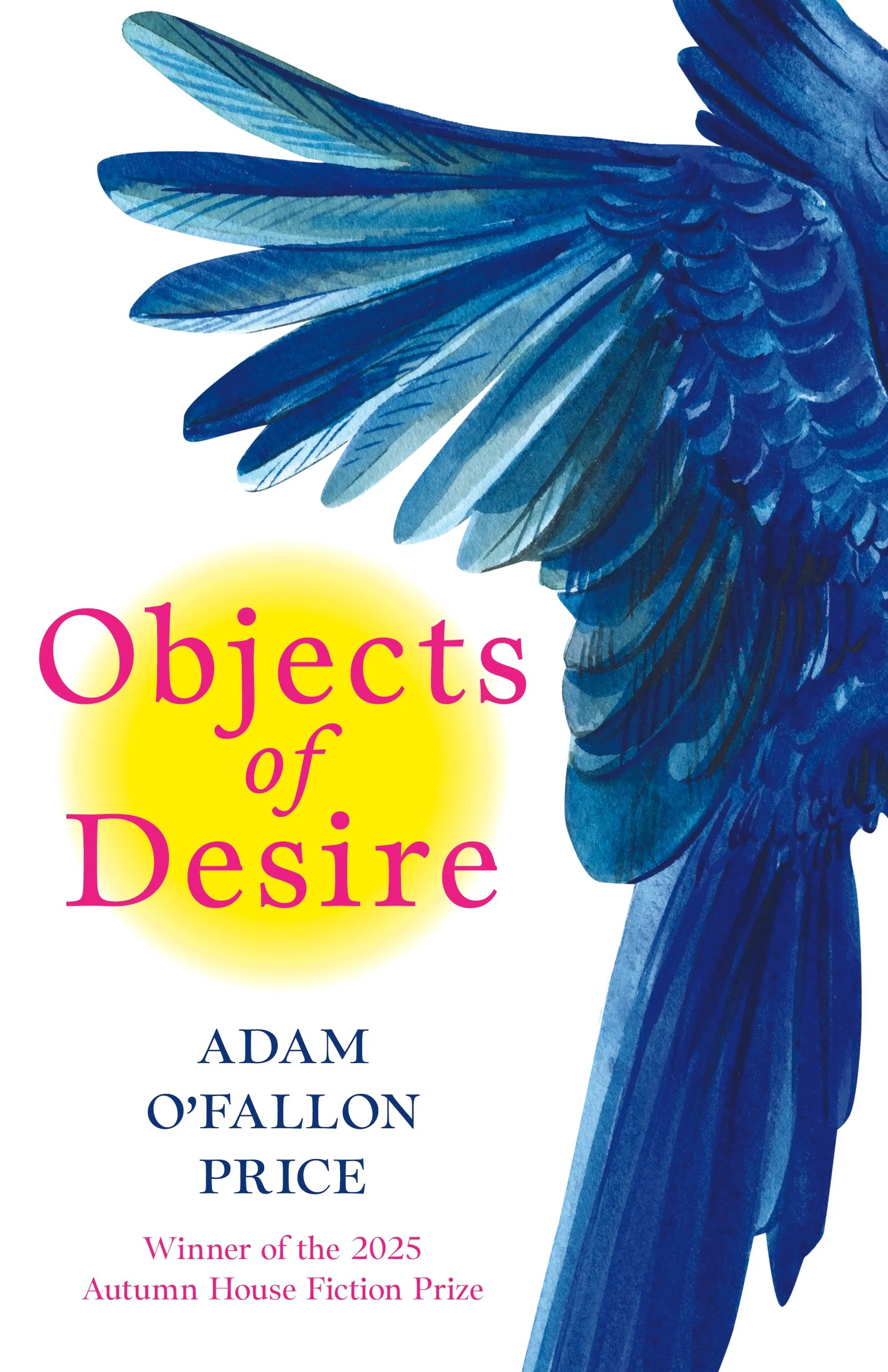
I’ve been a fan of Adam’s work for as long as I’ve known him. His writing has a confidence, a sturdiness, and a sense of humor that I find to be incredibly rare, especially in combination. I’ve given his book The Hotel Neversink as a gift multiple times; I’m not sure there is higher praise I know of when it comes to books. (I’d love to see lists of the books other writers give as gifts.) So many story collections are saddled with the weight of a forced thematic link between stories; I was glad to not find that here. That’s not to say a collection with a clear thematic focus can’t be good, but it’s nice to not have to speculate whether or not that focus was pushed on the writer by outside forces in hopes that the collection would be more palatable to a General Reader. The most obvious link between these stories is the only one that ultimately matters: quality. It’s honestly remarkable this collection did not exist already (a topic I delve into with my first question for Adam). I was thrilled to talk with Adam about his new story collection Objects of Desire.
Alex Higley: This first question I have might be better placed at the end or near the end of this conversation, but I wanted to open with it because it was the front matter of this collection that led me to it: Two of the stories in this collection appeared in The Paris Review and another two from the collection appeared in Granta (that is to say nothing of the remaining journals where stories from this collection appeared in: The Kenyon Review, EPOCH, and Narrative, among others). I think for many writers, the fact that this collection wasn’t already published, or published by a larger press, would underline the perceived diminished state of story collections in this country, as well as the current influence, or lack thereof, that publishing stories in venerated outlets now has in the United States. My question to you is, what is the less obvious understanding that people with those viewpoints might be missing?
Adam O’Fallon Price: Unfortunately, I think that viewpoint is largely correct. I do not say this with an ounce of arrogance (well, maybe a gram or two), but I have been about as well-published since I started publishing, as it’s possible to be short of becoming a New Yorker mainstay. My very good agent, whenever I would periodically ask about the possibility of shopping a collection, was consistently negative about the prospects—there simply, in her view, was not any interest, and the only way a collection was going to come out was if it was attached to the sale of a novel.
Ultimately, I decided to enter some contests, and I was fortunate enough to have Alexandra Kleeman select mine for the Autumn House Fiction Prize. I couldn’t be happier about the book, or the care and attention it’s gotten at AHP. But it is telling that a contest is basically the only available avenue for a writer like me to publish a collection. That said, my feeling is that this is really the direction in which all (fiction) publishing is moving, and it’s not necessarily a bad thing: it happened with poetry a long time ago, and short stories are maybe the canary in the coalmine for fiction, in terms of what the future will look like: small to very small presses run by people who are passionate and great at what they do, carefully making good books for a small but engaged readership.
Much of my favorite fiction has the cast of reality. There are places where the life of the narrator of your story “Sandstorm” resembles your own (and more places where it differs); is your instinct to begin a story with something “true” from your life?
Sometimes yes, and sometimes no. I mean, I believe on a fundamental level that stories are always “about” an author’s life, in the sense of the emotional reality and the problems being explored. But sometimes the subject matter is more explicit than other times. In the case of “Sandstorm,” as you say, it’s explicitly about the conflict between a creative writing professor and his student, although funny enough, at the time I started writing it (2010), I was the student. I mean, not that I had a conflict with a professor, but just the subject matter of classes and writing and striving felt personal to me.
There are multiple instances of “doubling” in this story. The narrator Paul is writing an autobiographical novel within a story that has shades of your autobiography. A short story written by a student entitled “Sandstorm” appears within this short story, also titled “Sandstorm,” and so on. This kind of “doubling” to me is exciting because the scaffolding of the story is visible and forefronted for the reader. Do you want your stories to feel “constructed” to a reader? In what way does underlining a craft decision strengthen a story?
This is such a good question. To answer it simply: yes. There’s something exciting to me, as well, about making the scaffolding of fiction visible/available to the reader—like, I know there’s a school of fiction writing thought that basically says the author should disappear. And I agree to an extent, you don’t want to constantly be nudging the reader, it becomes annoying pretty quickly. But what I like is when there’s the kind of doubling you’re talking about, these metafictional conceits, that are available to the interested reader. In other words, stuff that can easily be ignored by a reader who simply wants a good story—not a Robert Coover story where the metafiction apparatus is the entire point—but also where the imprint of the author is legible to a reader interested in that kind of thing.
I love the word “available” here. That’s my ideal experience as a reader: a writer who is giving me the opportunity to be in what appears as a type of lockstep with them. It’s illusory but also generous!
You teach creative writing at UNC Chapel Hill. I’m sure there are writers you could easily point to as influences on your work, but are there writers you’ve had as professors in the past that have significantly influenced your teaching?
The teacher I consider most formative and influential is a writer named Pam Durban, who taught at UNC for many years, and led the honors fiction class when I was there. She was my mentor. She is the person who got me my first publication—when I was in her class, she sent off a story of mine to AWP without telling me, for a new writers contest. I won and the story landed in Mid-American Review. As you know, getting that first publication monkey off your back is a really big moment, and I will always love her for doing that for me, at a time I wasn’t sure yet about submitting my work.
Mentorship is a funny thing—it’s obviously completely subjective, you don’t sign a contract with someone that says you will be their mentee now. It’s more than anything a feeling: this person has been an important figure in my life. The real reason I consider Pam my mentor—I’ve told this story many times—is because of a workshop of mine that went badly. I’d thought the story was really good (at the time, I thought all my stories were really good), and I talked to her afterwards in her office. I was like “I don’t get it, what’s the problem?” And she said, “You want to do this, right? Be a writer? Like really do this?” I said yes. She pointed at the paper copy of the story on her desk and said, “Well, then, this isn’t fucking good enough.” I remember walking out of her office, down the hall, in a total daze. I felt dejected but also braced, like I’d taken a shot of something strong. I knew she was right, and I knew I had to get a lot better than I was.
So to finally get back to your question—that moment stuck with me and significantly affected my work and work habits. But it also informed my future teaching by demonstrating something I think you have to learn as a teacher: different students need different things at different moments. Much of the time, students just need encouragement. Nothing kills more writing careers early on than lack of encouragement. But sometimes, students need their ass (metaphorically) kicked. I sure did, and you have to hone your sense, as a teacher, of who needs what, and when brutal honesty is the necessary thing.
Do you have particular fondness for the story, “Stone Lions,” as it appears to be the only one that had not previously appeared in a journal?
It actually just got placed in The Writer’s Chronicle, October edition. But I do have a special fondness for this story, actually. I really love the narrator and main character, Leigh. She’s a college women’s soccer player and obsessive about her sport. Her obsessiveness is clearly, in some ways, a psychological defense against some things that have happened to her, and against some of her mental/emotional tendencies. This is something I really relate to, except for me it’s writing instead of soccer—I’m really writing about myself, about behaviors I really understand, and I feel a huge amount of tenderness for this girl.
The advice “write what you know” I think is bad advice if taken as “you can only write about characters like you, people who have similar lives and experiences to your own.” I think fiction writers can and should put themselves in other people’s shoes, can and should imagine what it’s like to be an entirely different person from themselves. But I think it’s good advice in the sense of “you should write about emotional and psychological material you understand.” My first novel THE GRAND TOUR is about a Vietnam veteran who sells a memoir about his war experience late in life. I am not a veteran, nor have I fought in a way, nor was I, at the time of writing it, of advanced years (lol). But I had had a lot of experience with disappointment, with feeling like it would never happen for me, whatever it was. Likewise “Stone Lions”—I have no idea what being a female college athlete is like, but I know a lot about working obsessively and using work (sometimes to your detriment) to give your life meaning.
“Stone Lions” is a story about craft. Craft in the sense of athletics, not writing, but of course, also about writing. Was the genesis for this story rooted in an exploration of craft outside of writing and then you landed on soccer, or did you begin with soccer, specifically Leigh as a collegiate goalkeeper?
The genesis of the story, despite the aforementioned fact that I relate a lot to Leigh and definitely modeled her obsessiveness on my own, was actually with soccer itself. I had one of those dreaded 8 AM classes one semester, and on the walk from where I parked my car to class, I would pass the UNC soccer fields. And there was a women’s soccer goalie there every day, in all sorts of weather, working out by herself. Sometimes practicing her saves by leaping onto a mat over and over. And the image really stuck with me: this girl working her ass off, the commitment she had to her—as you say—craft, the unusual dedication for someone that age to be up at 7 AM, working out, when her friends were undoubtedly sleeping as late as they could. I felt a weird affection for this girl, and the story suggested itself from there…
Is there a version of this story with even more digs at Duke?
Haha, no, I felt like I got enough jabs in! It was fun though, when I realized I could make the opposing team Dook, and have her injure a Dook player. Revenge for Gerald Henderson busting Tyler Hansborough’s face (never forget).
There is such a wonderful familial density to “Marrow.” There is the initial predicament, the narrator, Steven, being asked to help his ex-wife with a favor, compounded by who it is that the favor benefits, Steven’s brother who married his ex-wife. This setup opens up rich narrative opportunity in the direction of learning more about the narrator’s ex-wife and the narrator’s brother all the while further characterizing the narrator for the reader. For yourself, how do you think about plot within short stories? What is the framework that is most helpful for you to craft such an inciting predicament, or series of predicaments? Is the framework you use to understand plot in your own work the same as the framework you teach to students?
On the most basic level, I think of plot as character meeting situation. The right person in the wrong situation; the wrong person in the right situation. The particularities and peculiarities of character and situation are what generate story. I teach this in my classes, but Hamlet is not only great but is even possible because Hamlet is the way is the way he is: dithering, insecure, smart, uncertain about the world. If Hamlet’s father’s ghost told Macbeth to avenge him, the play would be one act long: Macbeth would go kill Claudius immediately. Or vice versa, Hamlet in Macbeth would never kill Duncan to begin with.
In the case of “Marrow,” I was thinking about this sort of scummy real estate speculator, the kind of guy who owns like 8 LLCs and is constantly robbing Peter to pay Paul, shuffling his money around, trying to get rich. I was thinking about this guy in the story situation, being asked to do something selfless—not just selfless, but something against his personal interests. The most self-interested person in the world being asked to be selfless—that’s the engine of plot in this story, and everything that happens happens as a result of that set up. The initial problem creates further problems that put Steven under more and more pressure.
That’s the plot framework, as you put it, that I teach students—basically, an inciting predicament leads to a series of escalating predicaments. I mean, that’s the sort of the classic short story model in the much derided and reviled Freytag Pyramid sense. I don’t actually think all stories need to work that way—many don’t. But it’s useful to understand the basic mechanics of escalating dramatic action, the way this causes that which causes that which causes that as the pressure on the character steadily increases until they must act. But this all depends on the most fundamental element of dramatic action, which is The Problem (or The Predicament). If there’s not a problem, there’s not a story, and the problem typically amounts to a combination of character and situation.
Were there collections you were thinking about as you put together Objects of Desire? Maybe either as touchstones for how the collection is organized or otherwise?
To be honest, I was sort of thinking of albums more than collections. I had the idea of putting the flash piece, “Objects of Desire,” in the middle, and I really liked thinking about it as two sides. As with many albums, side A felt sort of poppier to me, and side B felt darker, weirder. The collection is kind of frontloaded with my “bigger” stories, the ones that were maybe published at larger venues and that have a sort of broader appeal. The second half of the collection has stories that are more idiosyncratic. Like a lot of things with writing, as I know you know, it sometimes helps to imagine a structure that makes sense to you, even if it’s invisible to everyone else.
What has been exciting you recently as a reader?
I’d been in a really awful reading rut for the last two years, the worst of my life, so partly as a strategy for getting out of it, I started reading books out loud with my wife. We read Mrs. Dalloway out loud, and Transcription by Ben Lerner, and a couple of stories, and now we’re doing Dayswork by Chris Bachelder and Jennifer Habel. It’s been really wonderful. First, just to shake things up and experience reading in a different way. But also to really absorb the language of the books we’re reading. I’d read Mrs. Dalloway before, twice, but it felt like I’d never read it. I think it’s sort of impossible—for me, anyway—not to skim when I’m reading, to a degree. And with a book like Mrs. Dalloway, you miss so much of the pleasure of the language—the small choices Woolf makes and the texture of the sentences. It’s also been a good reminder to me that I should always, at some point with my own writing, read it out loud, because you catch things you never otherwise would. I might never go back to just reading to myself!
As is tradition for Barrelhouse, I must ask, what is your favorite Patrick Swayze movie?
Then I must answer: Point Break
Adam O’Fallon Price is the author of two novels, The Grand Tour (Doubleday 2016) and The Hotel Neversink (Tin House Books 2019), which won the 2020 Edgar Award for Best Paperback Original, and a collection of short stories entitled Objects of Desire, forthcoming in October 2026 from Autumn House Press. His short fiction has appeared in Harper’s, The Paris Review, Granta, VICE, The Kenyon Review, The Iowa Review, EPOCH, and many other places. He lives in Carrboro, NC and teaches fiction writing at the University of North Carolina.
Alex Higley is the author of Cardinal (nominated for the PEN/Bingham Award), Old Open, and True Failure. He is a founding editor of Great Place Books.