
The Dirt Beneath Their Nails, by Marvin Garbeh Davis, Sr.
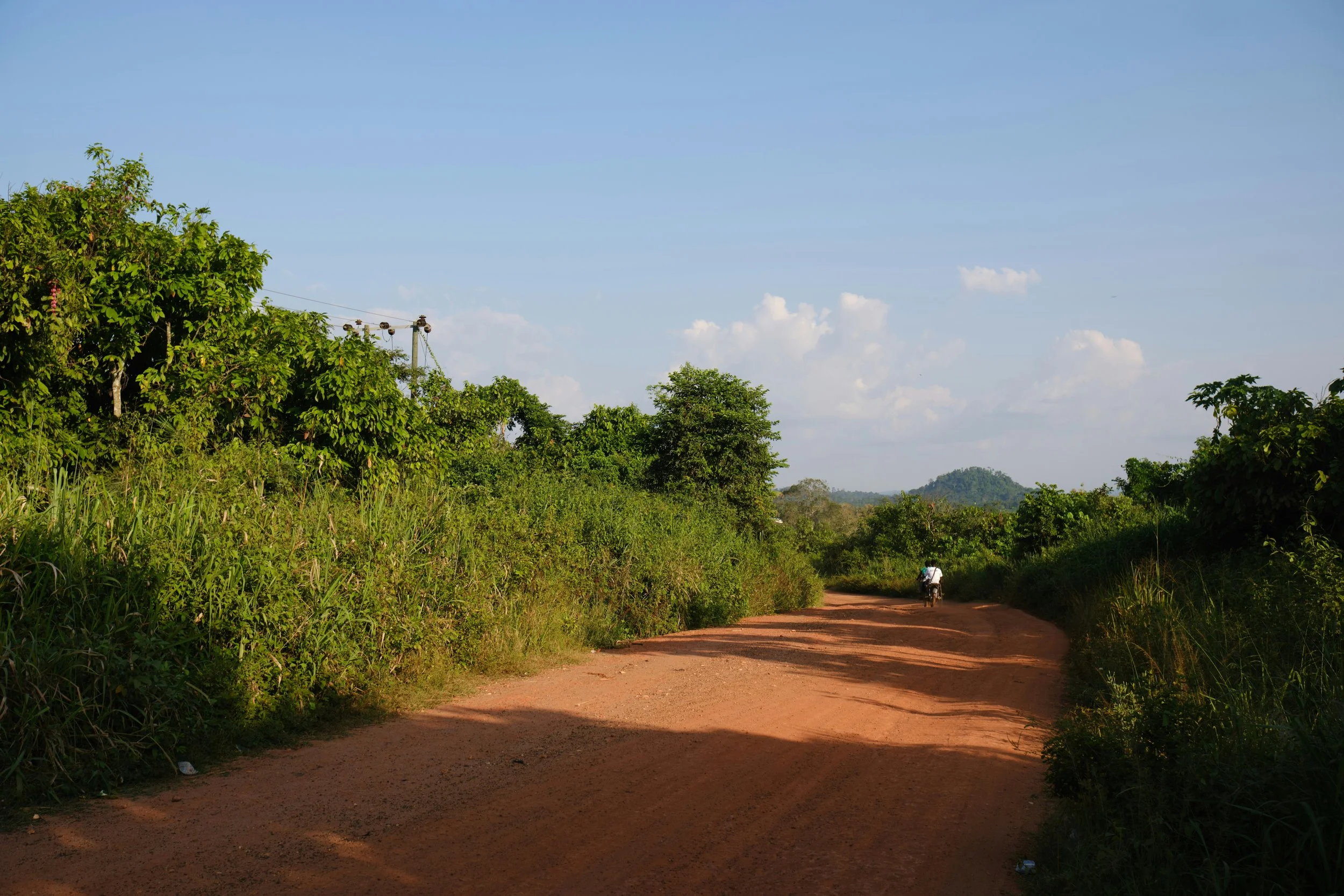
Photo by Alfred Quartey
The first time I arrived in Gbarma, the earth looked alive.
The earth was restless, pulsing beneath the relentless sun. Trucks moved slowly along the ridges, their tires grinding through the clay. Dust and diesel mingled, a taste that clung to the air as if the land itself was exhaling. My shoes were marked by the road, a path cut through the landscape, meant to bring change.
I was a young reporter sent by The Daily Mirror to cover a government project. The promise was to link the north to the capital and bring trade, jobs, and hope. But as I approached, the road seemed hungry. The hills opened like wounds, and the villages looked both expectant and uneasy.
My guesthouse sat at the edge of the construction camp, its tin roof clanging through the night. Each morning, before the sun burned off the mist, I heard the workers—pickaxes on stone, shovels on gravel. Their laughter entered the fog, fierce and resolute.
At noon, they came down to the creek to wash. The water turned blood-red as the mud slid off their bodies. I stood on the bridge and watched them. They sang old songs, work chants their fathers had taught them—songs that said, if you cannot win the world, at least you can shape its dust.
One man, older than the rest, waved at me. His name was Joe, a father of six. “You from Monrovia?” he called. I nodded. He smiled and studied the earth for a moment, then looked back at me, his eyes revealing a flicker of something unspoken. “You people come to write about progress. But progress got a price, my brother. The dirt knows,” he said, glancing briefly towards the mountains as if measuring a distance only he could see.
That night in my dim room, I wrote those words in my notebook.
The next morning, on site, the foreman wore dark glasses and a white hard hat, his voice sharp as the sun. The men moved like parts of a single machine—lifting, digging, and hammering. Their gloves were torn, their boots mismatched, their pay always late.
By midday, the heat shimmered so thick it bent the air. I saw Fayah, a boy who looked no older than sixteen, carrying a pickaxe taller than himself. He swung until his arms trembled, then laughed at his own exhaustion.
When I asked how long he’d been here, he said, “Since the road began.”
“Why not school?” I asked.
He looked at me with surprise. “You think school can eat?”
Later, as I stood near the slope, a vibration went through the ground. Someone shouted. The hillside above us shifted—soil rolling like a slow wave. The men ran, but the dust swallowed the last of their screams.
When it settled, five men were missing from the crew.
The following morning, they were replaced with new ones. The same shovels, the same songs. The road does not pause for grief.
That evening, I found the mother of one of the dead. She lived in a hut made of woven mats, her son’s boots hanging on the wall—cracked, red with clay, still heavy with his absence.
“They took his body,” she said softly, “but left his name in the soil.”
She led me to the mango tree near the old quarry. Beneath it, the workers buried the fallen. No headstones, no prayers—just a handful of earth and a silence too familiar to sound like mourning.
“They said the soil must be firm for the road,” she added. “Now it’s firm.”
Returning to my guesthouse, I declined dinner. I couldn't shake the image of those boots, colored by the land. That night I dreamed of hands rising from the dirt, not begging, but pointing—steady and sure.
Returning to Monrovia weeks later, the city's noise felt unreal. Billboards celebrated THE CORRIDOR OF UNITY — A ROAD TO THE FUTURE. The same road where five men had been buried like spare parts.
At the office, my editor scanned my draft. “Too dark,” he said. “Cut the dead men. Focus on progress.”
“But they died for it.”
He sighed. “Everyone dies for something. Make it hopeful.”
I refused. Instead, I sent the story to a friend overseas. No pay, no byline, just truth. A week later, I was dismissed.
That night, as I walked through Waterside Market, I saw the red dust again. It covered the mangoes, the shoes, the faces of the porters who carried goods for a dollar. Monrovia was far from Gbarma, but the dirt had followed—same color, same stubborn memory.
I realized then that the country was a circle. No one escaped the soil; we only learned to name it differently.
Years passed. The story faded from the papers, but not from me.
Years later, assigned to cover the road’s official reopening, I arrived for the ribbon-cutting, the speeches, the cameras—all bright and rehearsed. The minister called it “a monument to resilience.” I stood in the crowd and wondered if the families of the buried men had been invited.
After the ceremony, I slipped away and walked up the hill. The mango tree was still there. Its roots had cracked through the asphalt, stubborn as memory. I knelt beside it and brushed the dirt with my hand. A single coin glinted in the soil—someone’s offering, someone’s guilt.
A young boy stood nearby, polishing a motorbike. “You from the government?” he asked.
“No,” I said. “From the past.”
He laughed. “Then you know. This road eats men, but it feeds families.”
His laughter stayed with me as I walked away—light, unburdened, unknowing.
That night, at the guesthouse, the owner’s cousin poured me palm wine. The room smelled of kerosene and memory. He said business was better now, the town busier, the road busier.
“We are part of history,” he boasted.
“Whose history?” I asked.
He didn’t answer.
In my notebook, I wrote: Progress is a story the living tell, hoping to comfort themselves and honor the fallen.
At dawn, after a restless night, I went to the edge of the road. The workers were resurfacing another section, dust rising like breath. Among them was that same boy, now older, still laughing, still carrying the same shovel of his father’s generation. Watching him, a realization crystallized: once, I had witnessed and reported the stories of others; now, I understood my role was to ensure their voices echoed beyond the pages, demanding to be heard.
I watched until the sun turned the road gold. Then I reached into my pocket and pulled out a coin—one my father had once given me after his final tapping season on the plantation. He’d said, “For remembrance. So you don’t forget where sweat comes from.”
I pressed the coin into the dirt. “For you,” I whispered—though I didn’t know if I meant the boy, the buried, or the earth itself.
The ground was warm, trembling faintly under the trucks passing above.
As I straightened, the air smelled of dust, sweat, and palm oil—the scent of a nation still laboring to call itself alive.
The red earth never forgets. It holds every promise and every betrayal, the way a body holds breath.
It forgives slowly—if at all.
And the dirt beneath our nails is not just proof that we have worked.
It is proof that we have lived.
Marvin Garbeh Davis, Sr. is a Liberian writer whose fiction and poetry examine the intersection of memory, labor, faith, and the human condition. His work draws richly from plantation histories, river communities, and Liberia’s shifting social landscapes. He lives with his wife Angea in Monrovia, Liberia.