
In Between Times, I Swatted Flies, by Jason DeYoung
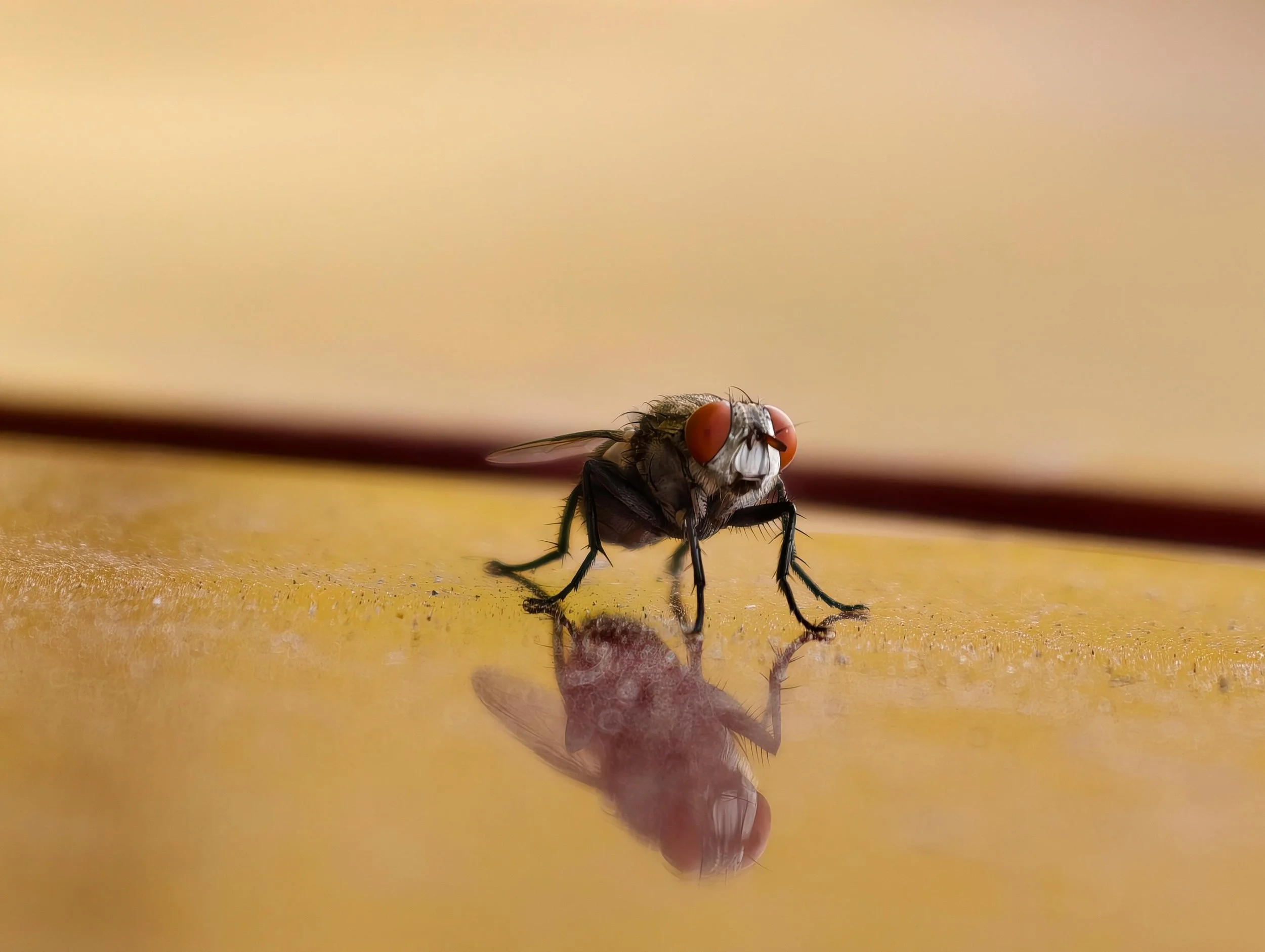
Art by Geruda
Whap!
I lift the flyswatter to consider the solitary black spot stamped into the orange pad. The fly’s front legs are already drawn, prayer-like, to its face. Its back legs twitch, curl back. And my upper lip recedes as I take a moment—perhaps a moment longer than necessary—to remember the lessons of an inexplicable ordeal that took place over the course of one humorless summer when I was plagued by flies. It was during the same summer I was out of work, and it was the last summer I would live in that narrow, white rowhouse on R Street. It was an austere place to be sure, with its broken old-timey gas fixtures, rusty turn-of-the-century ironworks, and all those worrying, expanding cracks that ran between its exterior bricks. The rowhouse had been affordable because it was tiny and in a less-than-desirable part of the city, where sirens, raids, and crime were not uncommon. My neighbors, however, were quiet—often absent—academics, students, and loose professionals—and during that summer they seemed to have all gone out of town at once, perhaps to escape the heat. And I was all alone—with my flies!
Some mornings I would gaze from the top of the basement steps to see the houseflies’ frantic carrying-on. It was never an ostentatious cloud of activity, per se, but an overabundant zipping from room to room, and a steady multiplying. The flies were all over the house, but the basement is where I had a little office, where I kept my papers and a reclining red chair. It was where the desktop computer lived and where I did telework, when I had it. When the flies first started appearing, I would kill each one. When their numbers grew, I continued to swat them. I’m embarrassed to say it now, but I became accustomed to their presence, and accustomed to killing them with a kind of pride-of-skill, as if it were my job to stalk and chase them. It filled the time while I was unemployed. And I think I loved the suspense, the wait before … whap!
I called exterminators, of course. Each one said something different. ‘Perhaps there is something dead under the house.’ ‘Perhaps it is your plants outside.’ ‘Perhaps it is the weather.’ They sprayed their acidic-smelling chemicals and then left. But one day, a young exterminator told me, ‘It’s hard for us to kill flies.’ He was too handsome to be a bug man, I thought. It was incongruous. His good looks, his profession. A man with a paunch: that’s an exterminator! The other exterminators had been men with paunches. One had a graying ginger mullet; another had an easily mimicked tic in his shoulders; and the most recent exterminator, a rather generic-looking man, had held forth at length under my portico on his passions for motorcycles and parakeets. All were pleasant men who looked the part. But the man who stood in my basement that day was beautiful. Imagine the most handsome man you’ve ever seen, blessed with understated charm and charisma, with farm-boyish warmth and a whisper of missionary sweetness—all this perfection before you in a dizzying eddy of houseflies. You, too, would think this man should pursue something other than extermination. Graced with these looks, this clear voice, this physique—why, why just kill bugs?
I talk like this now, but at the time, when I was out of a job, I thought: I’m not nearly as handsome as this guy. Why couldn’t I kill bugs, too? Is the job market so tough that this man—this Adonis, who is clearly intelligent—could not find other work? I remember I wanted to serve this man some coffee or something else so we could continue our conversation, so I could ask him more about his choices. I wanted to know how he got his head so hairless. I’d never shaved my head and polished it like he obviously did. But I could also tell that he wanted to be on his way. Likely I was being weird or likelier still he had elsewhere to be, other bugs to kill.
After he left, I returned to my basement office, where I ordered a few groceries from an online service, and looked for work and sent out résumés and cover letters for jobs I didn’t want. And felt the loneliness of flies all around me. Then later, once a few résumés were sent off, I resumed swatting. It was a dance that I got better at over time.
I installed fly ribbons and fly boxes with sticky tack near the windows to see if that would help. On some days, my real interest wasn’t the job listings at all, but observing those flies that had gotten stuck to the gummy ribbons or to the little paper boxes. How frantic they would buzz their glossy wings once they were held fast in the glue. All in terrifying futility. Often, it took days for them to die. Without any escape, mother flies would deposit their eggs into the stickiness. The cream-white larvae would wallow briefly in the goo and then, over the next couple days, dry up.
Whap!
I had a promised income of sorts that summer. When I wasn’t at my house killing flies, I was housesitting for the woman next door while she was away carrying out zoological research in Paraguay. We lived in adjacent rowhouses, sharing a modest firewall. She was cheerful, successful. She had a scattering of freckles that seemed to lurk under the surface during the winter and then emerge full bloom in the summer like something that enjoyed hibernation. The freckles married well with her slight red hair that framed her face in jouncy coils. She was a warm person. That’s how I imagined her—a person who was warm. But I didn’t know her well. No one really knew their neighbors well in that neighborhood. The housesitting job had come to me suddenly. One afternoon, earlier that summer, my neighbor knocked on the door, re-introduced herself and then said, all too quickly, ‘I have no one to really ask. Really!’ She’d gotten a last-minute grant, the original grantee dropping out due to circumstances unforeseen. My neighbor was off to Paraguay to study reptiles. ‘In two days! Oh, I know it’s so last minute. It’s last minute for me, too. Will you be here? Will you?’ I envied her. That’s all I could think about. She was successful. A heroine in her own right. Studying in Paraguay, like an old-time explorer. I could barely pay attention to her instructions. (This was before the flies, by the way, but I was still wounded from losing my job.) ‘Snakes.’ ‘Ferns.’ ‘Paraguay.’ ‘Helpful.’ ‘Flowers.’ ‘Neglect.’ ‘Environment.’ ‘Snakes.’ ‘Python.’ ‘Science.’ ‘Paraguay.’ ‘So thoughtful.’ ‘Paraguay.’ ‘Paraguay.’ ‘Paraguay.’ ‘While I’m away in Paraguay...’ She spoke a lot of words quickly that afternoon. Closer attention should have been paid if I was to be truly thoughtful.
She had a brightly lit house, and while she was gone that summer, I fed her plants—many of which looked exotic—and took short walks around her place to make sure everything was as it should be, and then I would examine the contents of her drawers and closets. My neighbor was no more interesting than most people. But her upstairs bathroom cabinets were well stocked with soaps and lotions and scrubs – in fact, her entire house smelled overwhelmingly of honeysuckle and gardenia. But this bathroom, with adjacent bedroom, was clearly her oasis. The day after I met the handsome exterminator was the first day I went over and took a bath in her tub. I was just so sick of my flies, you see. I luxuriated in sweet-smelling soaps and bubble baths while avoiding my basement, my flies, my cover letters, my résumés. In that soap-silken water, I reclined and hummed to myself an off-kilter tune, trying different harmonies, different rhythms, and wondered: if everything was connected —as an overly distracted professor once told me everything was—why did harmonies and beats have to be with in-sync to make a pleasing sound. Not everything was connected, I concluded frivolously. But then it was all music, as incongruous as it might be. There’s a lot to be fascinated by incongruity, I mused, smiling at the milk-white tile wall. My slantways shadow nodded its head in agreement. The riddle of music. The source of my flies. The puzzle of the beautiful exterminator. My shadow tilted its head as if equally intrigued.
As I look back on those days now, I remember that not having a job made me feel inexplicably eccentric, even to myself.
Whap!
I tried to get the beautiful exterminator to come back, but the company sent out an older man. He stood in the doorway, rawboned and smelling of cigarettes. One of his ears was gnarled into a knot and a duo of arrowhead-shaped scars pocked his left cheek. ‘Where’s the other guy,’ I asked, ‘the one who was here a few days ago?’ He believed I was making a stink about how his colleague hadn’t solved my fly problem. ‘There’s nothing we can do for flies, you know. I’m sure the other guy told you that,’ he said. Yes, he did, I explained, but I was hoping to—what? To talk to him again, but this time about how beautiful he was, too beautiful to be an exterminator, and how that didn’t—couldn’t!—square in my mind. I looked the older man in the eyes and said, ‘I must have misunderstood.’ And because I’d developed all sorts of curiosity about being an exterminator, I asked him how long he’d been doing the job. Again, he took it as an insult, as if I was questioning his expertise. ‘Son, I’ve been a bug man since before you were born. Nothing I can do for flies. Something’s dead, s’all. They’ll eat it up and then be gone. Flies are… dependable that way. They’re scavengers. They don’t want to live here.’ He looked over my left shoulder into my house as if I lived in something inhospitable, even for flies. (The interior of my house had been at the time what could be called, at best, male-minimalism.) ‘What about the other guy?’ I asked. ‘What other guy? There are about twenty of us in the office. You’ll need to be more specific.’ Could I ask for the one who looks like a young god?
So, I spent my first night over at my neighbor’s house. I bathed in her tub, and rested in her bed (on top of the duvet), and read the book she had left half-finished (half-started?) on the bedside table: William Golding’s Pincher Martin. Spoiler: Martin is dead the whole time. But, stranded at sea on his tooth-like perch, he fights like hell to stay alive, believing unreservedly that his first-world intellect will save him. Such a lonely guy. I felt a lot like Martin.
Just so I’m clear, my interest in the exterminator wasn’t sexual. Whap! I guess you could say that he had some sexual energy to him, though, and that’s what I was curious about: his sexual vibe and how it didn’t jibe with extermination. Looking back, I see I should have found other things to occupy my mind, but the flies were all-consuming. They zipped around me like, well, flies, and they suffocated my more general thoughts.
While I was over at my neighbor’s house, I got a call about one of my résumés. It was for a government agency, working as a private contractor, which meant I got none of the benefits of government work. I deleted the message. I’d been down that road before. It entailed a desolate desk at the end of a long hallway. It had been a meaningless position and included a lot of time staring down that aforementioned corridor, which was mostly empty, and only occasionally did people come out of their offices and cross the path. Hardly anyone spoke to me. Daily, before I arrived, I wondered if, when I showed up, the offices would be deserted, and on my desk a note instructing me to call a specific number, where there would be a message saying that the company had dissolved. My fantasy never materialized, and I eventually left for other employment. Telework, this time, which I enjoy, but has its own forms of silence.
After my night at my neighbor’s house, I ordered a coffee online and stepped down to the corner shop to pick it up. Only a young barista was in there and she didn’t look up when I took my coffee from the counter, a cup with my name misspelled on it. I returned home and sat in my basement and wondered about fantasies like the one about my private contractor job, and then I started to think about my fantasies regarding the exterminator. What if I spoke to him and got all my answers? Did I prefer my fantasy of him or did I really want the truth? On a small pad of paper, I scribbled a note to myself: Beware – reality exterminates fantasy. I sat back, felt mildly satisfied by my wordplay, although any child could muster a similar ‘clever’ thought. Still, satisfied. A huge fly landed on the pad, covering the word ‘fantasy.’ I looked away. Ah, exterminator. What were you up to? I pictured him being kind to others, walking around with his cans of poison in some lonely person’s apartment or house. Collecting a paycheck. I drifted off and woke to the tickle of a three-fly congress in my thigh hair.
Whap!
The next night, I soaked in my neighbor’s tub again and tried to read C. S. Lewis’s The Four Loves. I say I tried to read it because on the second page I found these highlighted words: “We are born helpless. As soon as we are fully conscious, we discover loneliness. We need others physically, emotionally, intellectually; we need them if we are to know anything, even ourselves.” These words felt explicably on the nose, and had also, at one time, seemed similarly important to my neighbor. How was I ever going to know anything more than flies and lonely nights? I put the book aside, and then decided to shave. I got out a fresh pink razor and shaved myself with a floral-scented cream. First my tatty beard went and then my head hair, although I had to stop midway to find a pair of scissors to cut the mass of it off. I felt the smoothness of my head and it felt strange and powerful, but naked, too. And then, because I was doing all sorts of new things, I got into one of my neighbor’s oversized t-shirts, one with the name of some cheerful-sounding day camp emblazoned across it and then went to sleep in her bed. When I left her house the next morning, the fresh air was cool on my newly shaved head. I stood in the sunlight and felt reborn.
But for fuck’s sake! No fresh shave, no self-discovering words of wisdom, no evening soak in a tub could rid me of flies. I was plagued! What in the hell was causing them? Where were they coming from? I called the exterminator company again. ‘Can you please send out the guy you sent out the time before last?’ I asked. ‘Who was that?’ the operator asked. ‘Don’t you keep records?’ I asked. ‘Of course, hold on, I’ll need to look that up.’ I could hear his fingers tapping keys. Whap! ‘Uh, well, it looks like it was Luke,’ the operator said. ‘Was he an older guy or a young guy?’ I could hear the person on the phone speaking to another person in the office. ‘Older. But Luke’s good.’ ‘No,’ I said. ‘I want the younger guy. He has a bald head. Handsome.’ More talk in the background. ‘Who is this?’ the operator wanted to know. ‘He was here a few weeks ago—to help me with flies,’ I said. ‘Not much we can do for flies, sir.’ ‘Your guy mentioned that. But could you send him out anyway? I’ll pay.’
And so, I waited. Whap! What the hell was I doing? Whap! The flies were getting worse. I looked at the clock. Fly guts were on it too—a dusky dollop of fly goop right over the 11. Whap! What was I going to ask the exterminator? Whap! Every one of the questions I planned to ask boiled down to ‘Help me?’ Help me with flies. Whap! Help me understand how a beautiful man like yourself can appear so successful, happy, content with extermination. Whap! Help me understand why I’m out of work. Whap! Help me understand why everything seems so off-kilter and wearying. Whap! Help me… resolve. Whap!
I waited. Much of that summer was about waiting. Extended waits and plagues seem universally married. Whap! Life, death, and waiting: those are three things everyone has in common. Yes, yes, there are others. I felt very edgy in those moments before the exterminator arrived. But waiting—that’s the one, isn’t it? The one that gets everyone. I’ve waited. You’ve waited. And swatted flies. Whap! At the appointed time, I saw a quiet and somewhat concealed figure cross in front of my basement window. And then that figure re-crossed. It was my exterminator! I nearly sprinted for the door. But first, I let him do whatever inspection he was conducting. I rubbed my shaved head, enjoying the glossy feel of it. Would he notice? I dashed upstairs and hid my appalling-looking flyswatter under the kitchen sink.
He walked from drainpipe to drainpipe. He looked around the brick wall that formed the outer rim of my small property. I could hear him lift the lid on the mailbox, and then close it. He ran his hand under a pile of mulch and then pulled it out. Empty. And then he disappeared. I waited some more. And then I heard the lid of my trash barrel clang down, and then more sounds from behind the house. I ran to see him peruse my backyard—opening the lid on the grill, looking under the car, pulling back the tarp that covered firewood. He looked up, but didn’t see me. He seemed to be thinking, pondering, studying the overall structure of the property. I watched his eyes follow the cracks in the exterior. Was that it? Did the cracks lead to the interior? Was the house cracking up? And then he disappeared again. I waited for the bell to ring, but all I could hear was the buzzing of flies and the thud of my heart. The next time I saw him, he was in the frame of my front door. I flung it wide and beckoned him in. ‘I’m so glad you’ve come,’ I said.
‘Spiders and flies, they are the toughest to get rid of,’ he said. ‘Spiders and houseflies – they don’t act like normal insects. You’d think since they’re bugs, they’d die like bugs, but no. They’re perplexing. Spiders aren’t really bugs anyway.’ ‘Fascinating,’ I said. I offered him some coffee. He declined. I offered water or juice or tea. Nada. I offered him a beer. He cut his eyes at me, and then said, ‘I’m good. Thanks.’ It wasn’t going as I’d imagined. We went into the basement. I told him here is where most of the flies live. ‘There’s likely something dead,’ he said. ‘You’ve all said that, but I can’t find it,’ I said. ‘They have all sorts of ways of getting in,’ he said. He pursed his plump lips, sniffed the air with his structured nose. I did the same. We were two bald men sniffing basement air. This made me strangely happy and I think I was grinning ear to ear at this point. But all I could smell was the lingering scent of earth that all basements have. We went out the basement’s back door and inspected a dirty-white drainpipe. He got down close to it and sniffed. He looked up at me. Gorgeous! ‘I need to ask you something,’ I said. He asked me to hold on just a sec and then went to another drain on the other side of the house, the one closest to my neighbor’s house. He put his face down to the pipe again, pulling in a nose-full of drainage air. He got up—‘Maybe’—and then shook his head. ‘You had a question.’
‘How can such a handsome man, such as yourself, be an exterminator?’ It burst out of my throat quickly, suddenly. His expression went blank, and then he guffawed. We were standing in the narrow stairwell between the two houses, my neighbor’s and mine. I could smell his breath. ‘Are you…’ he started, and then said: ‘It’s honest work, sir.’ I thought for a moment. Honest work? What of the annihilation he reckoned upon bug-kind every day? Of course, it was honest work, and this wasn’t a moral conversation. To say I wasn’t thinking clearly would be a colossal understatement. I swatted at a mosquito whining in my ear. I wasn’t asking the right question. I began again: ‘What I mean is: You’re so handsome. I would—well, just by looking at you, I would think a banker, lawyer, hell, male model.’ ‘Listen, I’m not gay.’ I quickly explained that I wasn’t either. And then went on further. I told him I was just out of work and bedeviled first by flies and then by his good looks and how it didn’t square with his job. Unfortunately, I said it all too fast—and a little smile came on his face. It was not a nice smile, but shielding and secretive at the same time. And in that moment, I knew something awful while looking into the eyes of the exterminator: I knew I would be a story; I would be a joke. A story told back at the office. And Luke and the others would laugh and laugh. The exterminator’s smile got wider, he cut his eyes again at me. I swallowed, hard, quivered. With nothing left to lose and (in a dubious effort) to change myself from a joke into something understandable, I explained how I had been living alone, tending to my neighbor’s house, soaking in her sweet-smelling soaps, trying on her clothes, reading her unfinished books, realizing that I really needed other people, and that I shaved my head and body to be more like him, and that I had been fantasizing about getting to talk to him once again, about his life choices and appearance, and whether I could glean something from that discussion—you know, universally—and all along, and in between times, I swatted flies. All these fucking flies! I was driven bonkers—that was my word, bonkers—by these flies. Then, I stepped decidedly toward him and took him by the arm. I squeezed: ‘Don’t you understand? You must. You must! You do this every day!’ The cornered exterminator dropped his smile, pulled his arm away, and held my gaze with an air of steely (yet shaken) professionalism. ‘I’m sorry, sir. There’s nothing I can do about flies.’
What had I expected? Relief, answers, a new path forward out of my solitude. Or was I in isolation? What’s the difference between solitude and isolation? One you choose, one you don’t, right. What kind of fucked up path had led my life to the point of parsing solitude and isolation? After I closed the door behind him, I looked at myself in the hallway mirror, hairless as a pupa. I tilted my head in the mirror and tried my best not to notice the sallow skin, the crooked nose, the weak jaw, the pudgy earlobes, and, of course, the eyes of indeterminate color looking back. I guess I’d mistakenly hoped his professional honesty would carry over to more philosophical conversation. As with many people, I half-heartedly concluded, my self-awareness extended only as far as it was convenient to me.
I didn’t call anyone else about the flies. Instead, I made conclusion after conclusion about the handsome exterminator. There were conclusions I liked best—hat he was just a mystery, a real person in a world of so many fakes and phonies. But that didn’t hold. The other conclusion I came to, albeit again simple-minded, was that beauty is in the eye of the beholder, and likely another person would see that he wasn’t so handsome, just a wholesome guy with a side satchel full of poisons. For the rest of the summer, after I’d killed all the flies I could tolerate (enjoy?) and sent out a few résumés, I went over to my neighbor’s and dowsed myself in her soaps and perfumes, my head bristling with a regrowth of black hairs. And because I’d gotten to where I enjoyed them, like a new skin, I’d don one of her silk nightshirts and lounge in her bed. I lacked the heart to do much more. I didn’t so much want to read my neighbor’s books anymore, either, many of which were scientific or academic (although she also had a large collection of nineteenth-century novels and short stories, which just didn’t appeal to me). Instead, I ate her frozen dinners and watched TV, enjoying marathon viewings on Bravo! All the glitzy, rich people on the TV acting badly casted a numbing effect. Whap! I killed a single fly with my hand in her bedroom, and prayed they wouldn’t invade here next.
My zoologist neighbor came home in late September, just as the weather began to cool off. She paid me the small amount of money she’d promised, and I was relieved to get it because without work I was living off the scraps of savings and needed cash. Paying exterminators ain’t cheap, either. I thanked her. She asked how my summer went. I said it’d been fine—lonesome, but fine. She too had been alone, with others who didn’t speak English, and so she too had had a ‘lonesome’ summer. ‘But I worked every day,’ she said, beaming.
And then, a few days later, after an early frost, the flies were gone. Gone! I wept. Wept like a solider might weep when the battle is over, win or lose. I looked around my basement and could see the carnage on just about every surface where I’d smashed a fly and its guts had squirted out and dried. The sticky ribbons and sticky box traps were speckled darkly with dehydrated flies, and I gathered them up and tossed them away. I started franticly cleaning. But eventually cleaning became too much and I had to rest. I never thought the flies would go away. I continued cleaning the next day, and the day after that. At first it was strange to have them disappear. Killing them had become such a habit. Like a person might miss a toothache or a limp, I honestly missed the burden of flies. Which makes no sense, but it’s true. I was suddenly free of a burden and, for a short while, to my surprise, I was made uneasy by freedom.
A few days later, I went out on my front steps to drink my morning coffee feeling lighter, happier. It was one of the first few days of true autumn and the first touches of genuine color were on the leaves. I had a job interview planned for that afternoon. I didn’t want the job, but I needed it, and if it were offered to me, I would take it. On the adjacent stoop, my neighbor came out in her running gear, already bouncing, plugging earbuds into her ears. ‘Hey, neighbor!’ she said. She was always cheerful. I waved, not saying anything, not knowing if she could hear me. She stopped bouncing and pulled an earbud out. ‘Just want to let you know, Poe died.’ Who? ‘My ball python. Edgar Allan Poe. He died while I was in Paraguay.’ She started bouncing again. What? She stopped. She explained that her six-foot long ball python, Poe, didn’t need to eat very often. ‘He can go up to six months without eating,’ she said. ‘I told you about him.’ Had she? ‘Evidently, he just up and died while I was away. Sorry,’ she said. ‘I hope he didn’t stink up the place. I guess you didn’t go down there.’ She winked. ‘Boy, he was rank.’ I couldn’t tell if it was a snide comment about my housesitting or whether she had figured out I’d been in her house a little too much, that I’d done more than just care for her plants. (Oh how, at the time, I really missed those nights!) ‘S’ok. You weren’t supposed to take care of him. I have a water filtration gizmo hooked up to the house,” she said. ‘But, snakes,’ she continued, ‘you can love them all you want, but most of them don’t care. Beautiful, perplexing creatures.’ She plugged her earbuds in again and trotted off. ‘Wait!’ I yelled. I was literally wringing my hands at this point. ‘I don’t mean to be gross but… were there any flies?’ She tilted her head, ‘You’re such an earnest guy.” She paused. ‘But no, I didn’t see any.’
With all those worrying cracks in the exterior, were there imperceptible cracks between the walls, too? Was it all the poison I’d had sprayed in my basement that killed Poe or was it Poe’s corpse that brought the flies? Were they even linked at all? Had she told me about him? Of course she had. I just wasn’t listening. Six-feet long?! There, on the other side of our shared wall, the whole time while I swatted flies.
Looking back on that morning, I remember I watched my neighbor run past the brightly painted townhouses, and the sun above her was pleasing in a way it hadn’t been in a while. A great, spotless ball of tangerine promise. The summer was over, and my flies were gone. ‘Hallelujah,’ I whispered in the cool sunlight. But what to make of those senseless months? Sometime over the following week, I made a promise to myself (although I wouldn’t always keep it). Every time I swatted flies, I would remember this summer and how easily it is to lose oneself in confusion and doubt. And that things pass, sometimes with definitive answers, but often as not, without.
Whap!
Jason DeYoung is the author of Waiting for the Miracle (The Cupboard Pamphlet, 2020). His fiction has appeared in Booth: A Journal, The Los Angeles Review, Numéro Cinq, New Orleans Review, and Best American Mystery Stories (Harcourt., 2012). He lives in Atlanta, Georgia.